21
八思巴文 孟郊 遊子吟
慈母手中線,遊子身上衣。
臨行密密縫,意恐遲遲歸。
誰言寸草心,報得三春暉。
Mongolian Square Script (Phags-pa script)
A Traveller’s Song
MENG Jiao (751-814 AD)
The thread in the hands of an amiable mother
Makes clothes for the body of her wayward son;
Carefully she sews and thoroughly she darns,
Dreading the delays that will keep him away from home.
But who says the heart of the inch-long grass
Can repay the warmth of the spring sun?
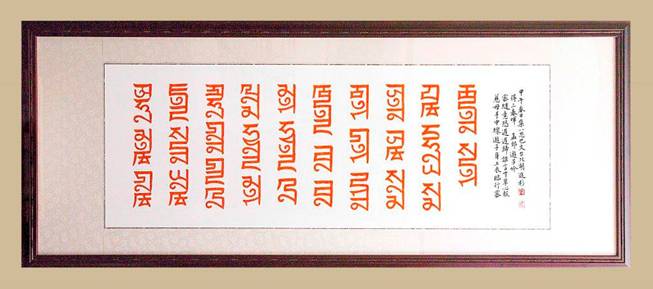
65.6 inches x 24 inches
※ ※ ※
八思巴文:元世祖忽必烈(1215-1294 AD)時,國師八思巴(1238-1279 AD)根據吐蕃文而制定的文字。然當時蒙古帝國已分裂為大元和四大汗國,八思巴字祇有元朝(1279-1367 AD)採用。明朝(1368-1644 AD)推翻元朝後,八思巴字遂廢棄不用。
The Mongolian Square Script (Phags-pa Script) is a writing style designed by the Tibetan monk and vice-king, Drogön Chögyal Phags-pa (1238-1279 AD), for Emperor Kublai Khan (1215-1294 AD) of the Yuan Dynasty (1279-1367 AD). Its usage was limited to the Yuan Dynasty and later fell out of use with the advent of the Ming dynasty (1368-1644 AD).
孟郊(751-814 AD),字東野,湖州武康(今浙江德清)人。現存詩歌五百多首,以短篇的五言古詩最多,代表作即為此首《遊子吟》。
MENG Jiao (751-814 AD) was born in Huzhou (now Deqin, Zhejiang Province). Most of his 500 some poems are written in the 5-character-per-line style, amongst which A Traveller’s Song is the most famous.
白話譯文
慈祥和藹的母親拿著針線,為將要出遠門的孩子縫衣服。
一針一線很細密的縫,既擔心孩子在外面受凍著涼,又憂心孩子在外面遲遲不回來。
子女的孝心就像微小的草,如何纔能報答慈母偉大的養育恩情啊!
