中國文字演進―胡進杉書法展
The Development of Chinese Character Scripts –
Calligraphy by HU Ching-San from Taiwan
中國文字演進―胡進杉書法展
駐邁阿密臺北經濟文化辦事處(前稱北美事務協調委員會駐邁亞密辦事處)自中華民國77年(1988)10月在佛羅里達州珊瑚閣市設立以來,致力強化臺灣與佛羅里達間各領域雙邊關係。
為進一步推廣臺佛兩地交流及宣揚中華文化,今年 2 月1日起駐邁阿密辦事處促成佛州中華學人協會暨佛州臺灣廠商聯誼會與佛羅里達州政府合作辦理「中國文字演進」書法展,展出臺灣知名書法家胡進杉先生作品,希望藉此展覽豐富臺佛雙邊合作內容並在文化交流方面建立新里程碑。
本書法展作者胡進杉先生學養豐富,現為國立故宮博物院圖書文獻處副處長,此次應佛州中華學人協會暨佛州臺灣廠商聯誼會邀請,提供展現中國文字演進史的各式書法計 16 種字體,32幅字,希望藉此將中文書寫之美及中華文化的博大精深介紹給觀眾。
佛州中華學人協會自民國74年(1985)年創立以來,致力推動臺灣與佛羅里達間之科技合作及學術與文化交流;佛州臺灣廠商聯誼會創立於民國83年(1994),旨在促進臺灣與佛羅里達間之商務及資訊之交流與合作。兩會能與佛羅里達州政府合辦此一巡迴書法展,極為榮幸。
佛州州務卿戴慈能對本展在州政府大樓22樓藝廊表示歡迎:「佛州政府有幸主辦『中國文字演進―胡進杉書法展』這麼重要的展覽殊感榮耀,國際文化交流豐富藝術家生涯,改善藝術品質及文化機構地位,並有助於增加參與的觀眾。」
透過對藝術的持續欣賞,文化交流有助於國際政經關係之強化。藝術提供人與人互動與信賴的途徑,激發靈感並拓展美感潛質。經由真誠的文化交流建立的友誼與理解終將促進國際和平。文化交流亦有助於國際共同價值的深層理解。展現一族羣特殊成就以充實另一族羣―將使所有參與者都藉以提升。
臺灣向以領航中華文化為己任,在文化保存與藝術傳揚方面不遺餘力,書法展是靜態的,歡迎所有的朋友們前往科技進步創新與文化生活多元的寶島臺灣觀光訪問,實地體驗臺灣人民的熱情好客,親眼目睹自由、民主、開放的社會裡人民的生活方式,並觀賞寶島的富麗美景,品嚐集合中外精華的著名美食及參觀藏有眾多瑰寶的國立故宮博物院!
佛州中華學人協會
佛州臺灣廠商聯誼會 謹識
佛州州務院文化局
The Development of Chinese Character Scripts –
Calligraphy by HU Ching-San
from Taiwan
Since its establishment in October 1988 in Coral Gables, Florida, the Taipei Economic and Cultural Office in Miami (TECO in Miami, formerly the Coordination Council for North American Affairs, Miami Office) has devoted itself to the promotion of bilateral relations between Taiwan and the State of Florida.
In order to further enhance Taiwan-Florida cultural exchange and advocate the richness of Chinese culture, TECO in Miami assists in presenting “The Development of Chinese Character Scripts – Calligraphy by HU Ching-San from Taiwan,” an exhibit jointly hosted by the Chinese American Scholars and Professionals Association of Florida (CASPAF), Florida Taiwan Business Association Foundation, Inc. (FTBA), and the government of the State of Florida. The exhibition, from February 1, to April 30, 2016, is a circuit exhibition displaying thirty-two calligraphic works of Mr. HU Ching-san. The presentation of Mr. HU’s work marks a milestone in cross-cultural exchange, as it enriches the cultural fabric shared between Taiwan and the State of Florida.
At the request of CASPAF and FTBA, the cultivated and well-learned HU Ching-san, Deputy Chief Curator of the Department of Rare Books of the National Palace Museum of the Republic of China (Taiwan), has provided sixteen types of calligraphic art that depict the development of Chinese characters. Through introducing audiences to the beauty of Chinese calligraphy, the exhibition aims to display the depth and power of Chinese culture.
Since its establishment in 1985, the Chinese American Scholars and Professionals Association of Florida (CASPAF) has made great contribution to the strengthening of scientific, technical and academic, and cultural exchange between Taiwan and the State of Florida. Florida Taiwan Business Association Foundation, Inc. (FTBA), established in 1994, has dedicated itself to the exchange and cooperation of commerce and trade information between Taiwan and Florida. CASPAF and FTBA are proud to have the honor of co-hosting the exhibition together with the State of Florida.
Florida Secretary of State, Ken Detzner welcomes this exhibition in the 22nd Floor Capitol Gallery.
“We are honored to host this important exhibit of the Development of Chinese Character Scripts – Calligraphy by Hu Ching-San from Taiwan. International cultural exchanges enrich the lives of artists, improve artistic qualities and capabilities of cultural organizations, and help build audiences.”
Cultural Exchanges also promote economic and political relations among nations through an increased awareness of one of the most fundamental aspects of society – the arts. The arts provide a people-to-people relationship, an effective path to intimacy, authenticity, and trust, igniting inspiration and exploring aesthetic possibilities. In the long run promoting peace among nations through friendships and the understanding that result from genuine cultural exchanges. Because the arts and culture play a major role in the fabric of societies, cultural exchanges can, and often do, lead to a deeper understanding of shared values between nations. Showcasing the unique accomplishments of one group for the enrichment of another – that is one experience that is always transforming for everyone involved.
Taiwan has long taken upon itself the role of a standard-bearer at the leading edge of Chinese culture, and has dedicated itself to the preservation of culture as well as the propagation of the arts. The host organizations welcome and encourage all friends to visit the technology-advanced and multi-cultural Taiwan. Go and experience the world-renowned hospitality and passion of Taiwanese people. See with your own eyes the way of living in a free, democratic, and open society. Enjoy the spectacular scenery of this beautiful island. Taste the famous delicious cuisines that not only combine the essences of the old and the new, but are also from all over the world. And, most of all, be sure to visit the place that preserves a great many treasures – the National Palace Museum.
Chinese American Scholars and Professionals Association of Florida
Florida Taiwan Business Association Foundation, Inc.
Florida Department of State, Division of Cultural Affairs
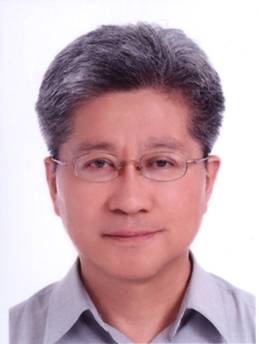
胡進杉先生小傳
胡進杉先生,臺灣省彰化縣人,1953年生,臺北市立建國高級中學、臺灣大學經濟學系、政治大學邊政研究所畢業,1981年至故宮博物院服務迄今,現為該院圖書文獻處副處長。
自幼喜歡書畫,長隨王愷和、施孟宏兩位先生學習書法,從牟崇松、黃渠成教授研習山水畫,書法創作除傳統真、草、隸、篆外,並從事西夏、藏文、滿文等少數民族文字書法之研究。書畫作品,曾參與海峽兩岸及日、韓、美等地聯展數十餘次,作品並為公私機構所收藏。現為九愚書畫會、臺北市畫學研究會、中華世紀書畫協會、中華亞細亞藝文協會會員。並擔任臺北法光佛學研究所書法班指導老師。
Mr. HU Ching-San
Born in 1953 in Changhua County, Republic of China (Taiwan), Mr. HU Ching-San entered National Taiwan University after graduating from Taipei Municipal Jianguo High School. He received a master’s degree from the Institute of China Border Area Studies, at National Chengchi University. HU served at the National Palace Museum since 1981, and was recently promoted to Deputy Chief Curator of the Department of Rare Books and Documents in 2014.
Greatly enamored with brush writing and painting since childhood, HU learned brush writing with Kai-Ho WANG and Meng-Hung SHIH, and studied shan shui (mountain and stream) painting under Chung-Sung MOU and Chu-Cheng HUANG. Apart from traditional Chinese scripts, HU is also versed in the writings of minority tribes, such as the Xixia (Tangut) Regime Script, the Tibetan Script, the Mongolian Square Script (Phagspa Alphabet), as well as the Manchurian Script.
HU has participated in joint exhibitions on both sides of the Taiwan Strait, as well as Japan, Korea, and the United States of America. His works are collected by public and private organizations.
HU is currently a member of the Nine Fools Arts Club, the Taipei Arts Study Association, the Chinese Century Arts Association, and the Chinese Asian Arts Association. He is also a calligraphy instructor at the Fa-Kuang Institute of Buddhist Studies in Taipei.
|
1 |
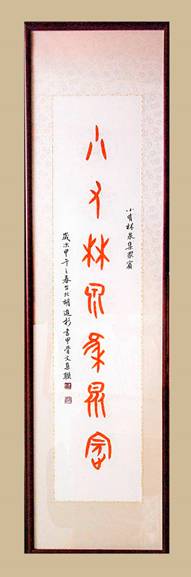
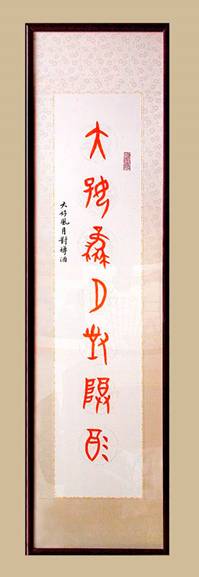
甲骨文 對聯 大好風月對罇酒 小又(有)林泉集眾賓
Oracle Bone Script (jiaguwen) Savoring glorious scenery with mellow wine. Crowding intricate garden with erudite guests.
※ ※ ※ 甲骨文,又稱契文,主要為商朝(1765-1122 BC)晚期王室用於占卜記事而在龜甲或獸骨上契刻的文字,為目前已知已成體系最早的中國文字,上承原始符號,下啟青銅銘文。現代的漢字即由甲骨文演變而來。 清末金石學家王懿榮(1845-1900 AD)於光緒二十五年(1899)從河南安陽小屯村出土的盤庚遷殷至帝辛亡國之273年之古物中發現了甲骨文。目前學者已自發掘的16萬多片甲骨中,解出5千個不同的字,其中可確定辨認的有1,600多字。 全世界蒐藏最多且已完善整理甲骨文的中華民國中央研究院自民國93年(2004)起開始將保存的4萬5千多片甲骨文進行數位典藏工作。 請參見:http://rub.ihp.sinica.edu.tw/或http://rub.ihp.sinica.edu.tw/~oracle/home.htm
Most of the existing Oracle Bone Script have been excavated from Anyang City, Henan Province, the seventh and last capital of the Shang Dynasty (1765-1122 BC). Only in 1899 did the Garrison Commander WANG Yi-Zon (1845-1900 AD) of the Qing Dynasty Capital Peking begin to notice that the inscriptions on the so-called “Dragon Bones” from Xiaotun Village outside of Anyang were actually meaningful script. The Oracle Bone Script found to the present date was used from about 1300 BC. It consists of short texts inscribed on ox scapulae and turtle plastrons, which were used for divination. Some 160,000 fragments with inscriptions of the Oracle Bone Script have been preserved. The inscriptions contain approximately 5,000 individual characters; 1,600 of which have been successfully deciphered by scholars. The Academia Sinica of the Republic of China (Taiwan) has the largest and most well-managed collection of oracle bones in the world, and since 2004, has undertaken the digitalization of its 45,000 bone fragments. For more information, please visit: http://rub.ihp.sinica.edu.tw/ (website in Chinese version only) or http://rub.ihp.sinica.edu.tw/~oracle/home.htm |
15.2 inches x 57 inches (each) |
|
2 |
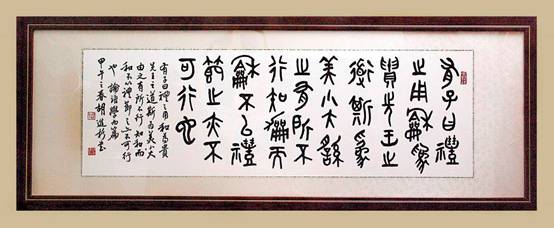
鐘鼎文 論語 學而篇 有子曰:禮之用,和為貴,先王之道斯為美。小大由之,有所不行,知和而和,不以禮節之,亦不可行也。
Bronze Vessel Script (zhongdingwen) The Analects, Xue-Er Chapter YOU Tzu said, “In the actual practice of propriety, harmony is essential. This is what the ancient kings did so well—both the greater and the lesser abide by it. Yet be aware: if you understand harmony and use it, but do not structure yourself with propriety, things will not go well.” |
65.6 inches x 24 inches |
|
|
※ ※ ※ 鐘鼎文:亦稱金文,乃鑄或刻於青銅器上之文字。始於商朝晚期,盛於西周,紀錄內容多為當時社會,尤其是王公貴族的活動,多為祀典、賜命、征伐、圍獵及契約之事。以周宣王時期所鑄毛公鼎金文(又稱西周金文)為代表。迄今發現的鐘鼎文,經統計,共有3,005字,可辨識者1,804字,比甲骨文略多。由於商周盛行青銅器,而青銅禮器以「鼎」為代表,樂器以「鐘」為代表,因其刻於金器、大鐘上,故稱鐘鼎文。 請參見西周晚期宗周鐘及其銘文: http://www.npm.gov.tw/exh99/bell/2_en.htm http://www.npm.gov.tw/exh99/bell/big006_en.htm http://www.npm.gov.tw/exh99/bell/big007_en.htm http://www.npm.gov.tw/exh99/bell/big008_en.htm 毛公鼎文字: http://www.npm.gov.tw/exh99/bell/big001_en.htm http://www.npm.gov.tw/exh99/bell/big002_en.htm http://www.npm.gov.tw/exh99/bell/big004.htm
The Bronze Vessel Script, also commonly referred to as the Bronze Script, were writing on ritual bronzes such as zhōng (bells) and ding (tripodal cauldrons) from the Shang Dynasty (1765-1122 BC) to the Zhou Dynasty (1121-249 BC) and even later. Early bronze inscriptions were almost always cast with a stylus in the wet clay of the piece-mold from which the bronze was then cast, while later inscriptions were often engraved after the bronze was cast. Inscriptions recorded activities for contemporary affairs, including those involving rituals, conferring positions or assignments, expeditions and battles, hunting, and making contracts among nobilities. Please refer to Zong Zhou Zhong of the Late Western Zhou Dynasty and its casted script: http://www.npm.gov.tw/exh99/bell/2_en.htm http://www.npm.gov.tw/exh99/bell/big006_en.htm http://www.npm.gov.tw/exh99/bell/big007_en.htm http://www.npm.gov.tw/exh99/bell/big008_en.htm Mao Gong Ding and its casted script: http://www.npm.gov.tw/exh99/bell/big001_en.htm http://www.npm.gov.tw/exh99/bell/big002_en.htm http://www.npm.gov.tw/exh99/bell/big004.htm
論語:孔子和他的弟子及再傳弟子言行為主的匯編,是儒家重要的經典之一。 The Analects is a collection of aphorisms from Confucius, his disciples, and his disciples’ disciples. It is the most important book in Confucianism.
孔子(551-479 BC),名丘,字仲尼。春秋末期魯國教育家與哲學家,曾任魯大司寇。刪詩書、訂禮樂、贊周易、著春秋,是儒學和儒家的創始人。學不厭、教不倦,使孔子成為「至聖先師」。他主張有教無類,將前此貴族所獨有之禮樂教育普及於平民,學生多至三千人。西漢武帝時,董仲舒(179-104 BC)進言罷黜百家獨尊儒術,奠定了儒家兩千年來的正統學派地位,孔子並被尊為萬世師表。 Confucius (551-479 BC) was born into a rather impoverished family of noble descent in Lu State (within modern Shantung Province). His Chinese name was KONG Chiu, with a courtesy name Zhong-ni. After resigning from his post as minister of Lu State, he travelled to many parts of China. He was, and still is, regarded as the most famous Chinese philosopher and educator. His policy was to accept any person as a disciple, provided that the student was genuinely eager to learn. This idea was revolutionary in a society in which education was the exclusive privilege of the aristocracy. He is credited with educating 3,000 students. He is also one of the first Chinese philosophers to leave behind a collection of teachings that can be reliably ascribed to his philosophy - The Analects. Confucius authored or edited the following works: Classics of Poetry, Book of Documents, Book of Rites, I Ching, and the Spring and Autumn Annals. During the reign of Emperor Wu of the West Han Dynasty (141-87 BC), the Confucian scholar and Imperial courtier DONG Zhong-Su (179-104 BC) recommended and adopted the policy to “reject other schools of thoughts, [and] respect only Confucianism.” Since then, Confucius was highly regarded as the Model for All Ages.
有子,即有若(518-458 BC),字子有,魯國人。「七十二賢」之一。 YOU Tzu (518-458 BC), one of Confucius’ 72 best disciples, also born in Lu State.
白話譯文 有子說:禮法的運用,以和為貴。這是最美好的傳統,適用於一切事情。但僅知道「和為貴」是不行的,違反禮法而講「和」是絕對不行的。 |
|
|
3 |
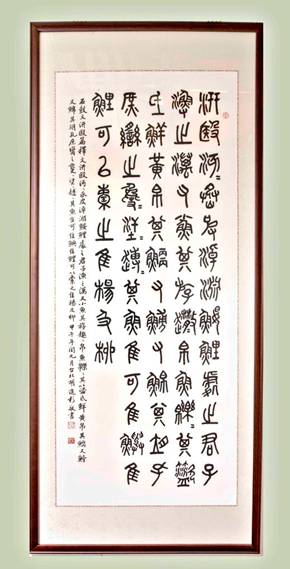
石鼓文 第二鼓 汧殹篇 汧殹沔沔,丞皮淖淵。 𩷑鯉處之,君子漁之。 澫又(有)小魚,其斿𧽾𧽾。 帛魚𤾾𤾾,其𥶎氐鮮。 黃白其𩺂,又(有)鰟又(有)𩸊。 其𦚎孔庶,臠之𣬐𣬐。 𡊺𡊺𧽢𧽢,其魚隹(唯)可(何)? 隹(唯)鱮隹(唯)鯉,可(何)以𣞉之,隹(唯)楊及柳。
Stone Drum Script (shiguwen) Second Drum: Qian River Quietly flows the Qian River, forming deep muddy ponds here and there; with shoals of catfishes and carps, there comes King Qin to fish. Carefree swim small fishes in the gully, scales flashing in the water; fresh fishes struggle in the bamboo traps. What a sight! Yellow breams and white mud carps, abounding in pairs; fish flip and flop in migration. What are the catches? Chubs and carps. How to preserve them? Poplars and willows everywhere to make the containers. |
33.3 inches x 78.6 inches |
|
|
※ ※ ※ 石鼓文,先秦刻石文字,因其刻石外形似鼓而得名。發現於唐初,共十枚,徑約三尺,分別刻有大篆四言詩一首,共十首,計七百一十八字。內容最早被認為是記敘周宣王出獵的場面,故又稱獵碣。因被棄於陳倉之野,同時也稱陳倉十碣。 The Stone Drums are ten granite boulders bearing the oldest known drum shape “stone” inscriptions in ancient Chinese. The ten Stone drums were excavated in the beginning of Tang Dynasty (618-907 AD) in the rural area of Chengcang (now Baoji of Shanxi Province), There are four-character poems carved on each stone with 718 Large Seal Script characters in total. There are several interpretations of their origin. The Stone Drums are the oldest known stone inscriptions in China, making them a priceless treasure for epigraphers. The Drums vary in height from 73 cm to 87.5 cm (with one which was at one point used as a mortar reduced by the grinding to 58 cm), and from 56 to 80.1 cm in diameter. The Stone Drums weigh about 882 pounds each.
白話譯文(中華民國國立故宮博物院器物處前處長張光遠先生譯文) 啊!汧水湧流,注成了許多泥潭。 潭中有鰋魚及鯉魚,秦君來釣魚了! 石澗處有小魚,悠閒自在地游著; 白色的魚,在水中閃鑠著,捕魚籠裏的魚,活鮮鮮的,實在美極了! 黃色的魴魚及白色的鮊魚,成雙結對地並游著。 一眼看去,好多啊!魚腹疾速翻閃。 成羣地往來迴游著。所釣的是什麼魚呀! 是鰱魚及鯉魚。用什麼來裝盛呢?到處有楊條柳條可取材作盛具哩! |
|
|
4 |
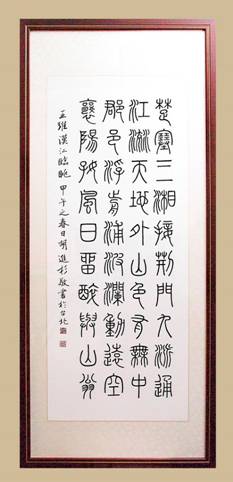
小篆 王維 漢江臨眺 楚塞三湘接,荊門九派通。
Small Seal Script (xiaozhuan) A View from the Han River WANG Wei (699-759 AD) Fort Chu sits where the three rivers meet, around Mt. Jingmen nine tributaries compete; the Grand River surges, transcending heaven and earth, colors on the hills appear and fade as time goes forth. Towns and burghs emerge on banks yonder, waves and tides thunder reaching far into the distance; enchanting is the scenery of Xiangyang on a day so fine, the right time to stay and get drunk with my old chum. |
29.3 inches x 69.8 inches |
|
|
※ ※ ※ 小篆:秦始皇(260-210 BC)統一六國後,厲行書同文,由宰相李斯(280-208 BC)主政,為中國首次有系統地將文字標準化。因為是以秦國(770-206 BC)使用的書體為基礎,因此小篆又被稱為「秦篆」。小篆的筆劃較細,在字形上呈長方形,結構左右對稱,給人挺拔秀麗的感覺。 The Small Seal Script: Following the unification of China and the establishment of the Qin Dynasty (221-206 BC), Qin Shi Huang (260-210 BC) decreed to unify the system of writing. Prime Minister LI Si (280-208 BC) thus implemented the Small Seal Script to be the official script used throughout the whole Empire. The Small Seal Script was also known as “Qinzhuan,” because it was modeled after the Large Seal Script from the earlier Kingdom of Qin (770-206 BC). Compared to the Large Seal Script, the Small Seal Script is easier to write and appears more symmetrical, with long, even strokes in an oblong shape.
王維(699-759 AD),生於蒲州,詩人兼畫家,多才多藝,善於描寫山水景物和田園風光,成了山水田園詩派的傑出代表。佛教思想的介入,成為王維晚期作品避世的主導思想,人稱「詩佛」。蘇軾(1037-1101 AD)曾說:王維的「詩中有畫,畫中有詩」。 WANG Wei (699-759 AD), born in Puzhou (now Yuncheng, Sanxi Province), achieved eminence as a poet and a painter. He is especially known for his compositions in the shan shui (mountain and stream) poetry genre. A devout Zen Buddhist in his old age, WANG was posthumously known as the “Poet Buddha.” SU Shi (1037-1101 AD) once commented: “The quality of WANG Wei’s poems can be summed up as that the poems hold paintings within them. Moreover, in observing his paintings, you can see that, within the painting, there is poetry.”
白話譯文 漢水流經楚塞,又接連折入三湘;荊門山處匯合九條水源。 浩瀚江水彷彿流到天地之外;朦朧山色遠在虛無飄渺中。 沿江的郡邑恰似浮在水面之上;水天相接的邊際,波濤激盪滾動。 襄陽的風景,著實令人陶醉讚嘆;我願留在此地,陪伴常醉的山翁。 |
|
|
5 |
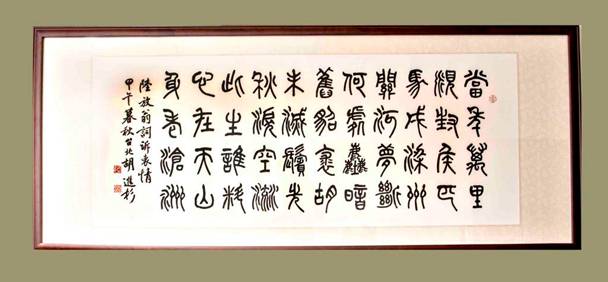
小篆 陸游 訴衷情 當年萬里覓封侯,匹馬戍梁州。 關河夢斷何處?塵暗舊貂裘。 胡未滅,鬢先秋,淚空流。 此生誰料,心在天山,身老滄州。
Small Seal Script (xiaozhuan) Su Zhong Qing: Expressing My Innermost Feelings LU You (1125-1210 AD) In years gone by – ten thousand miles, I traveled, to seek my Honor; Alone on horseback, O Liangzhou, I was there to guard you. Of border passes, rivers – where has my broken dream gone? Outworn my sable coat of cavalier. The Tartars are still there, as before – hoar are the hairs at my temples; in vain do my tears pour. To foretell such a life, who could dare? My heart is at the Tian Shan frontier, my ageing body, at Cangzhou, here! |
87.8 inches x 27.4 inches |
||
|
|
※ ※ ※ 小篆:秦始皇(260-210 BC)統一六國後,厲行書同文,由宰相李斯(280-208 BC)主政,為中國首次有系統地將文字標準化。因為是以秦國(770-206 BC)使用的書體為基礎,因此小篆又被稱為「秦篆」。小篆的筆劃較細,在字形上呈長方形,結構左右對稱,給人挺拔秀麗的感覺。 The Small Seal Script: Following the unification of China and the establishment of the Qin Dynasty (221-206 BC), Qin Shi Huang (260-210 BC) decreed to unify the system of writing. Prime Minister LI Si (280-208 BC) thus implemented the Small Seal Script to be the official script used throughout the whole Empire. The Small Seal Script was also known as “Qinzhuan,” because it was modeled after the Large Seal Script from the earlier Kingdom of Qin (770-206 BC). Compared to the Large Seal Script, the Small Seal Script is easier to write and appears more symmetrical, with long, even strokes in an oblong shape.
陸游(1125-1210 AD),字務觀,號放翁,越州山陰(今浙江紹興)人。後人每以陸游為南宋詩人之冠。陸游詩中多展現強烈的愛國情感,是他最大的特色與傳頌千古的原因。陸游現留詩作約一萬一千首,為現留詩作最多的詩人。 LU You (1125–1210) was a prominent poet of the Southern Song Dynasty. At the age of two, LU’s family followed the Court after the collapse of the Northern Song , moving to Shanyin (now Shaoxing of Zhejiang Province). A prolific writer in his lifetime, LU You composed roughly eleven thousand poems in both the shi (詩) and ci (詞) forms. His works have been noted for their strong sense of patriotism, which is the major reason they have been valued for centuries.
白話譯文 當年萬里遠赴邊境,為了功名,獨自戍守梁州。 而今軍旅生活在殘夢中乍醒,舊時出征的貂裘已滿積灰塵。 胡人還未滅,兩鬢已飛霜,感傷國事的淚也白流了。 這一生誰能預料,志在抗敵天山,如今卻要老死滄洲了! |
|||
|
6 |
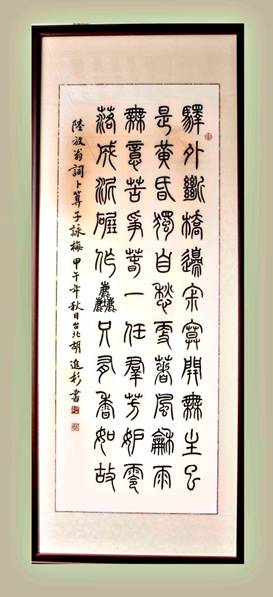
小篆 陸游 卜算子 詠梅 驛外斷橋邊,寂寞開無主。 已是黃昏獨自愁,更著風和雨。 無意苦爭春,一任羣芳妒。 零落成泥碾作塵,只有香如故。
Small Seal Script (xiaozhuan) Lyrics to the Melody of Divining Numbers: Praises of Plum Blossoms LU You (1125-1210 AD) Outside the post station by the broken bridge, in loneliness bloom wild blossoms. Dusk has settled and I dwell in melancholic solitude, weathering wind and rain. I have no intention to bitterly contest for spring’s arrival, the flowers instead can jealously endure. Each fall to the ground and once pulverize into the dust, leaves only sweet fragrances as always. |
27.3 inches x 67.7 inches |
||
|
|
※ ※ ※ 小篆:秦始皇(260-210 BC)統一六國後,厲行書同文,由宰相李斯(280-208 BC)主政,為中國首次有系統地將文字標準化。因為是以秦國(770-206 BC)使用的書體為基礎,因此小篆又被稱為「秦篆」。小篆的筆劃較細,在字形上呈長方形,結構左右對稱,給人挺拔秀麗的感覺。 The Small Seal Script: Following the unification of China and the establishment of the Qin Dynasty (221-206 BC), Qin Shi Huang (260-210 BC) decreed to unify the system of writing. Prime Minister LI Si (280-208 BC) thus implemented the Small Seal Script to be the official script used throughout the whole Empire. The Small Seal Script was also known as “Qinzhuan,” because it was modeled after the Large Seal Script from the earlier Kingdom of Qin (770-206 BC). Compared to the Large Seal Script, the Small Seal Script is easier to write and appears more symmetrical, with long, even strokes in an oblong shape.
陸游(1125-1210 AD),字務觀,號放翁,越州山陰(今浙江紹興)人。後人每以陸游為南宋詩人之冠。陸游詩中多展現強烈的愛國情感,是他最大的特色與傳頌千古的原因。陸游現留詩作約一萬一千首,為現留詩作最多的詩人。 LU You (1125–1210) was a prominent poet of the Southern Song Dynasty. At the age of two, LU’s family followed the Court after the collapse of the Northern Song , moving to Shanyin (now Shaoxing of Zhejiang Province). A prolific writer in his lifetime, LU You composed roughly eleven thousand poems in both the shi (詩) and ci (詞) forms. His works have been noted for their strong sense of patriotism, which is the major reason they have been valued for centuries.
白話譯文 驛站外的斷橋邊,寒梅孤寂地綻放。 已是黃昏時刻,梅花除了兀自愁思外,還要頂住風雨的摧殘。 開在百花之先的梅花,並不是刻意爭奪春光,但也祇能任由羣花嫉妒。 縱然隨風飄落,經過車騎行人的踏輾,爛在泥中,也還保持著一貫的清香。 |
|||
|
7 |
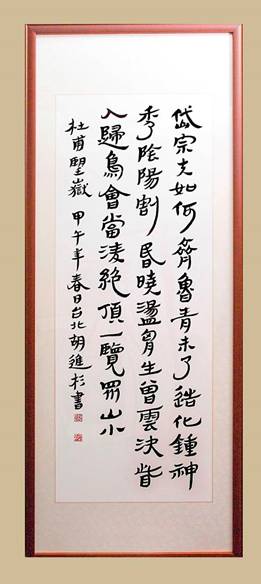
簡牘文字 杜甫 望嶽 岱宗夫如何,齊魯青未了。 造化鍾神秀,陰陽割昏曉。 盪胸生層雲,決眥入歸鳥。 會當淩絕頂,一覽眾山小。
Bamboo Slip Script (jiandu) Staring at Mt. Tai DU Fu (712-770 AD) What shall I say of the Great Tai? Its lush green covers the states of Chi and Lu, inspired and stirred by the breath of creation, with ying and yang balancing day and night. Deepening my breath toward opening clouds, my eyes straining to see the home-coming birds. One day I shall reach the top to belittle all mountains by a single glance. |
26 inches x 67.3 inches |
|
|
※ ※ ※ 簡牘文字:古人刻或寫在竹片、木片上的文字。簡牘是在紙普及之前用來記述的載體。所有出土古簡上之文字,皆用毛筆蘸黑墨書寫。未用漆書,亦不用刀刻。 漢簡:http://ndweb.iis.sinica.edu.tw/woodslip_public/System/Main.htm(僅中文) The Bamboo Slip Script was known to be carved or inscribed on long, narrow strips of bamboo before the invention of paper. Yet the texts on all of the excavated bamboo strips are discovered to be written by brush in black ink. None of them were written with paint or carved by knife. Please refer to the Bamboo Slip Script of the Han Dynasty: http://ndweb.iis.sinica.edu.tw/woodslip_public/System/Main.htm (Chinese only)
杜甫(712-770 AD),河南鞏縣人,作品對中國影響極深,傳詩約一千五百首。後人尊稱杜甫為「詩聖」,他的詩多描寫平民生活及戰亂流離,也被稱為「詩史」,是中國史上有名的社會詩人。 DU Fu (712-770 AD) was born in Gong County, Henan Province. His works hold enormous influence on Chinese literature; among which, approximately fifteen hundred poems have been preserved. His poetry reflects the conditions of his era, namely the suffering of the people from battles, drought, starvation, and displacement. DU was honored by later generations as the “Poet-Historian” and the “Poet-Sage.”
白話譯文 泰山啊,你究竟有多宏偉壯麗? 挺拔蒼翠緜延齊魯兩地。 造物者給了你瑰麗和神奇, 你高峻的山峰,把南北分成晨夕。 望層層雲氣升騰,令人胸懷盪滌, 看歸鳥迴旋入山,使人眼眶欲裂。 有朝一日,我總要登上你的絕頂, 把周圍矮小的羣山一覽無遺! |
|
|
8 |
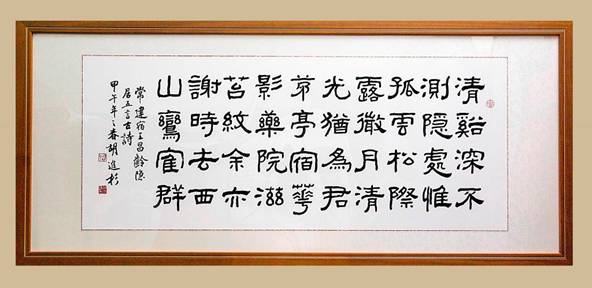
隸書 常建 宿王昌齡隱居 清谿深不測,隱處唯孤雲。
Clerical Script (lishu) poem Staying Overnight at WANG Changling’s Retreat CHANG Jian (708-765 AD) Here, beside the clear fathomless lake, you live accompanied by a lone cloud; Clear through the pine the moon arrives to be your own pure-hearted friend. Resting beneath a thatched pavilion among the flowers’ shadow, the dewy peonies flourish in their bed of moss. Let me leave the world. Let me alight on the western mountain with phoenixes and cranes.
|
65.7 inches x 28.7 inches |
|
|
※ ※ ※ 隸書:源於秦朝(221-206 BC),在東漢(25-220 AD)時期達到頂峰,故有「漢隸唐楷」之稱。秦始皇(260-210 BC)在書同文的過程中,命李斯(280-208 BC)創立小篆後,也採納了程邈(生卒年不詳)整理的隸書。小篆書寫速度較慢,而隸書化圓轉為方折,提高了書寫效率。 呂世宜(1784-1855 AD)隸書:http://www.npm.gov.tw/exh96/donation9604/ch02.html Although originating from the Qin Dynasty (221-206 BC), the Clerical Script reached its climax in the following Han Dynasty (206 BC-220 AD). In conjunction with the Small Seal Script by LI Si (280-208 BC), Qin Shi Huang (260-210 BC) also accepted the Clerical Script, compiled by CHENG Miao (birth and death unknown). The highly rectilinear structure of the Clerical Script makes it easier and faster to write than the Small Seal Script. Clerical Script by LU Shiyi (1784-1855 AD): http://www.npm.gov.tw/exh96/donation9604/en02.html
常建(708-765 AD),唐玄宗開元十五年(727 AD)與王昌齡(698-756 AD)同登進士榜。詩多五言,常以山林、寺觀為題材,也有部分邊塞詩。詩語清新自然,意境清幽澄澈。作品中流露出淡泊名利的隱士情懷。 CHANG Jian (708-765 AD) passed the highest and most prestigious level of the imperial examination together with WANG Changling (698-756 AD) in 727 AD. Most of his poems are written in the 5-character-per-line style on the themes of forest and temples, while others depict hardships of life on the frontier. His style is fresh and natural, with a hint of tranquility and clarity. There is a mood of out-of-the-world reclusiveness imbued in his works.
王昌齡(698-756 AD)善寫場面雄闊的邊塞詩,多抒寫戰士憂國立功及邊城艱困環境與思鄉之情懷。其詩氣勢雄渾,格調高昂,尤其是將七絕推向高峰,故有「七絕聖手」的美譽。 WANG Changling (698-756 AD) is best known for his poems describing the wide expanses, hardships, heroic deeds, and military confrontations in the frontier regions of northwestern China. His poems contain a powerful, lofty, and ebullient sweep. Elevating the 7-character-per-line genre of Chinese poetry to its peak, he was regarded as the “Master of 7-character-per-line poems.”
白話譯文 清澈的溪水深不可測,王昌齡隱居的地方,祇有孤獨的雲; |
|
|
9 |
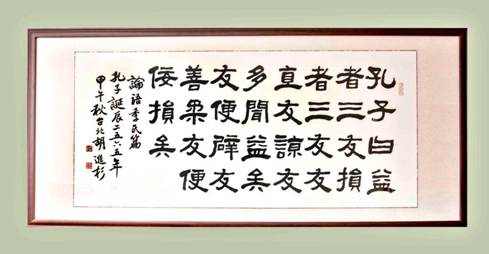
隸書 論語 季氏篇 孔子曰:益者三友,損者三友。友直,友諒,友多聞,益矣。友便辟,友善柔,友便佞,損矣。
Clerical Script (lishu) The Analects, Ji Shi Chapter Confucius said, “There are three friendships which are advantageous, and three which are injurious. Friendship with the upright, friendship with the sincere, and friendship with the man of erudition - these are advantageous. Friendship with the man of specious airs; friendship with the insinuatingly soft; and friendship with the glib-tongued - these are injurious.” |
68 inches x 30.8 inches |
|
|
※ ※ ※ 隸書:源於秦朝(221-206 BC),在東漢(25-220 AD)時期達到頂峰,故有「漢隸唐楷」之稱。秦始皇(260-210 BC)在書同文的過程中,命李斯(280-208 BC)創立小篆後,也採納了程邈(生卒年不詳)整理的隸書。小篆書寫速度較慢,而隸書化圓轉為方折,提高了書寫效率。 呂世宜(1784-1855 AD)隸書:http://www.npm.gov.tw/exh96/donation9604/ch02.html Although originating from the Qin Dynasty (221-206 BC), the Clerical Script reached its climax in the following Han Dynasty (206 BC-220 AD). In conjunction with the Small Seal Script by LI Si (280-208 BC), Qin Shi Huang (260-210 BC) also accepted the Clerical Script, compiled by CHENG Miao (birth and death unknown). The highly rectilinear structure of the Clerical Script makes it easier and faster to write than the Small Seal Script. Clerical Script by LU Shiyi (1784-1855 AD): http://www.npm.gov.tw/exh96/donation9604/en02.html
論語:孔子和他的弟子及再傳弟子言行為主的匯編,是儒學重要的經典之一。 The Analects is a collection of aphorisms from Confucius, his disciples, and his disciples’ disciples. It is the most important book in Confucianism.
孔子(551-479 BC),名丘,字仲尼。春秋末期魯國教育家與哲學家,曾任魯大司寇。刪詩書、訂禮樂、贊周易、著春秋,是儒學和儒家的創始人。學不厭、教不倦,使孔子成為「至聖先師」。他主張有教無類,將前此貴族所獨有之禮樂教育普及於平民,學生多至三千人。西漢武帝時,董仲舒(179-104 BC)進言罷黜百家獨尊儒術,奠定了儒家兩千年來的正統學派地位,孔子並被尊為萬世師表。 Confucius (551-479 BC) was born into a rather impoverished family of noble descent in Lu State (within modern Shantung Province). His Chinese name was KONG Chiu, with a courtesy name Zhong-ni. After resigning from his post as minister of Lu State, he travelled to many parts of China. He was, and still is, regarded as the most famous Chinese philosopher and educator. His policy was to accept any person as a disciple, provided that the student was genuinely eager to learn. This idea was revolutionary in a society in which education was the exclusive privilege of the aristocracy. He is credited with educating 3,000 students. He is also one of the first Chinese philosophers to leave behind a collection of teachings that can be reliably ascribed to his philosophy - The Analects. Confucius authored or edited the following works: Classics of Poetry, Book of Documents, Book of Rites, I Ching, and the Spring and Autumn Annals. During the reign of Emperor Wu of the West Han Dynasty (141-87 BC), the Confucian scholar and Imperial courtier DONG Zhong-Su (179-104 BC) recommended and adopted the policy to “reject other schools of thoughts, [and] respect only Confucianism.” Since then, Confucius was highly regarded as the Model for All Ages.
白話譯文 孔子說:有益的朋友有三種,有害的朋友有三種。結交正直的朋友,誠信的朋友,知識廣博的朋友,是有益的。結交諂媚逢迎的人,結交表面奉承而背後誹謗別人的人,結交善於花言巧語的人,是有害的。 |
|
10 |
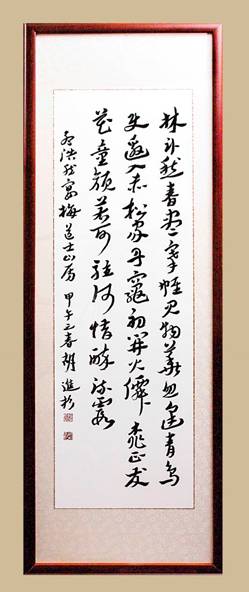
章草 孟浩然 宴梅道士山房 林卧愁春盡,搴帷覽物華。 忽逢青鳥使,邀入赤松家。 丹竈初開火,仙桃正發花。 童顏若可駐,何惜醉流霞。
Clerical-Cursive Script (zhangcao) A Banquet at the House of the Taoist Priest MEI MENG Haoran (689-740 AD) In my hammock among the woods, grieving that spring must end, I draw the curtain to savor nature’s splendor. All of a sudden, a bluebird bade me come to his dwelling-place among the crimson pine. What a flame for his alchemical crucible— immortal peach-trees magical with blooming buds! If childish features could be kept forever and ever, why should we care about being drunken with the rosy-flowing wine. |
21.3 inches x 64.3 inches |
|
|
※ ※ ※ 章草:漢初,為減省或連綴隸書的筆畫,開始出現了隸書的草書,由於漢章帝(57-88 AD)喜好草書,因此被稱為章草,特點是字字獨立。 The Clerical-Cursive Script (zhangcao) functions primarily as a kind of shorthand script or calligraphic style. Developed during the Han Dynasty (206 BC-220 AD) as a cursory way to write the popular but inchoate Clerical Script, the Cursive Script was favored by Emperor Zhang (57-88 AD) and commonly called zhangcao.
孟浩然(689-740 AD):唐代山水田園詩派代表作家之一。年青的時候在家鄉鹿門山(今湖北襄陽)隱居讀書,到了四十多歲,纔到京城長安應考進士,想求得一官半職,大展政治抱負,可惜願望未能實現,但和王維(692-761 AD)、李白(701-762 AD)、王昌齡(698-765 AD)等結成了詩友。詩多以景物風光及山水田園生活為題材。 MENG Haoran (689-740 AD), except during a brief pursuit of an official career in his forties, mainly lived in and wrote about the Lu-meng Mounts (east of Xiangyang, Hubei Province) where he was born and raised. MENG was a major influence on contemporary and subsequent poets of the Tang era (618-907 AD) because of his focus on the theme of nature in his poetry.
白話譯文 高臥林下,正愁思春光將盡,掀開帘幕,欣賞著良辰美景。 忽然遇見神仙(指梅道士)的信差,原來是赤松子邀請我訪問他家。 煉丹的金爐灶剛剛升火,院中仙桃也正好滿樹開花。 如果仙酒真可以保住童顏,就不要吝惜流霞酒,且暢飲一番。 |
|
|
11 |
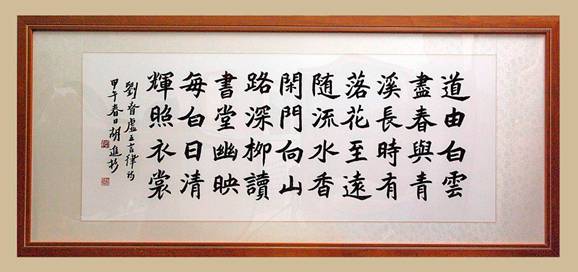
魏碑 劉眘虛 五言律詩(闕題) 道由白雲盡,春與青溪長。 時有落花至,遠隨流水香。 閑門向山路,深柳讀書堂。 幽映每白日,清輝照衣裳。
Wei Stele Script (weibei) Poem without Title LIU Sheng-Xu (714-? AD) On a road stretching towards the white clouds, the spring air permeates along the blue stream. Petals come drifting with the wind, the brook carrying their fragrance all the way. My quiet gate faces a mountain trail, and among the willow trees lodges my study. Sunlight sifts through the dense foliage, my garments reflect the clear and soft light. |
65.6 inches x 28.6 inches |
|
|
※ ※ ※ 魏碑:也稱北碑,是南北朝時期北朝的碑刻書法作品。現存的魏碑書體都是楷書,因此有時也把這些楷書碑刻作品稱為「魏楷」。這些碑刻作品主要是以「石碑」、「墓誌銘」、「摩崖」和「造像記」的形式存在的。 The Wei Stele Inscription (weibei) refers to the calligraphic works on stele inscriptions of the Northern Dynasty (439-581 AD) in the period of the Northern and Southern Dynasties (420-589 AD). The style is characterized by elegant, natural, and poised strokes, emitting a sense of sturdiness and simplicity.
劉眘虛(714-? AD):自幼聰穎,八歲作文上書,受到皇帝賞識,拜為童子郎。但日後仕途失意,壯年辭官南歸,遊歷各地。晚年定居洪州(今江西省靖安縣),築「深柳讀書堂」,著書自娛。為山水田園派詩人。 LIU Sheng-Xu (714-? AD) was noted for his cleverness since childhood. At the age of eight, he wrote a letter to the emperor who appreciated his talents so much he was thus appointed Tongzilang (child scholar). His career in officialdom, however, did not fare well during adulthood. Frustrated, he resigned and traveled to the south, settling in Hongzhou (now Jingan County, Jiangxi Province). In his later years, LIU established the Willow Study Hall, amusing himself by collecting books. He has been classified as a landscape-pastoral poet.
白話譯文 山路被白雲隔斷在塵境之外,春光宛若清清溪流源遠緜長。 不時有落花隨溪水飄流而至,遠遠地就可聞到水中的芳香。 閒靜的荊門面對蜿蜒的山路,柳蔭深處正是我讀書的齋堂。 和煦的陽光穿過柳蔭的幽靜,清新的光輝便灑滿我的衣裳。 |
|
|
12 |
唐楷 禮記 禮運篇大同章 大道之行也,天下為公,選賢與能,講信修睦,故人不獨親其親,不獨子其子,使老有所終,壯有所用,幼有所長,鰥寡孤獨廢疾者皆有所養;男有分,女有歸,貨惡其棄於地也不必藏於己,力惡其不出於身也不必為己,是故謀閉而不興,盜竊亂賊而不作,故外戶而不閉,是謂大同。
Regular Script (kaishu) The Great Way Record of Rites, Li-Yun-Da-Tong Chapter Confucius (551-479 BC) When the Great Way prevailed, every person was a part of public society, and public society belonged to everyone. The virtuous and the able were chosen for public office. Fidelity and friendliness were valued by all. People not only loved their own parents and children, but loved the parents and children of others as well. The elderly lived their last years in happiness; able-bodied adults were usefully employed; children were reared properly. Widowers, widows, orphans, the childless aged, the crippled and the ailing were well cared for. All men shared their social responsibilities, and all women performed their domestic duties in married life. Natural resources were fully used for the benefit of all, and not appropriated for selfish ends. People wanted to contribute their strength and ability to society for public good but not for private gain. Trickery and intrigue could not occur in such a society. Robbery, larceny and other crimes all disappeared. Gates and doors were not locked; no one ever thought of stealing. This was the Age of the Great Commonwealth of peace and prosperity. |
42.5 inches x 103.25 inches |
|
|
※ ※ ※ 唐楷:唐朝(618-907 AD)在楷書方面的成就最為後世推崇,字體以法度嚴謹著稱,在中國書法史上與秦篆與漢隸並列。 The Regular Script (kaishu) is considered to have matured stylistically during the Tang Dynasty (618-907 AD). It is famous for the strictness and clearness of its strokes. In Chinese calligraphy, the Regular Script of the Tang Dynasty ranks alongside the Small Seal Script of the Qin Dynasty (221-206 BC) and the Clerical Script of the Han Dynasty (206 BC-220 AD).
孔子(551-479 BC),名丘,字仲尼。春秋末期魯國教育家與哲學家,曾任魯大司寇。刪詩書、訂禮樂、贊周易、著春秋,是儒學和儒家的創始人。學不厭、教不倦,使孔子成為「至聖先師」。他主張有教無類,將前此貴族所獨有之禮樂教育普及於平民,學生多至三千人。西漢武帝時,董仲舒(179-104 BC)進言罷黜百家獨尊儒術,奠定了儒家兩千年來的正統學派地位,孔子並被尊為萬世師表。 Confucius (551-479 BC) was born into a rather impoverished family of noble descent in Lu State (within modern Shantung Province). His Chinese name was KONG Chiu, with a courtesy name Zhong-ni. After resigning from his post as minister of Lu State, he travelled to many parts of China. He was, and still is, regarded as the most famous Chinese philosopher and educator. His policy was to accept any person as a disciple, provided that the student was genuinely eager to learn. This idea was revolutionary in a society in which education was the exclusive privilege of the aristocracy. He is credited with educating 3,000 students. He is also one of the first Chinese philosophers to leave behind a collection of teachings that can be reliably ascribed to his philosophy - The Analects. Confucius authored or edited the following works: Classics of Poetry, Book of Documents, Book of Rites, I Ching, and the Spring and Autumn Annals. During the reign of Emperor Wu of the West Han Dynasty (141-87 BC), the Confucian scholar and Imperial courtier DONG Zhong-Su (179-104 BC) recommended and adopted the policy to “reject other schools of thoughts, [and] respect only Confucianism.” Since then, Confucius was highly regarded as the Model for All Ages.
白話譯文 大道施行的時代,天下國家是大家的,為大家所共有、共治、共享,而不是專制私有的;選任賢德且有能力的人來擔任領導者,人人都講求誠實信用,邦族鄉鄰之間彼此修好,和諧、合作、和平;於是人們不祇親愛自己的父母至親,不祇愛護自己的兒女子弟,也敬愛別人的父母及慈護別人的子女;使老年人都能安享天年,壯年人都能貢獻智能,兒童們都有良好的養育、教育與培育;鰥夫、寡婦、孤兒、獨老無子的人、以及殘廢、疾病的人,都能受到足夠的照顧和供養;男的各有適當的職份工作,女的各有適合的家庭歸宿;那時人們厭惡將貨物資源廢棄於地上,也不見得祇為了自己纔護置它;人們嫌惡自己有能力卻不肯出力,也不見得祇為了自己纔願出力;所以,就没有謀財害命的陰謀發生,也没有偷竊強盜的亂象出現,是故,門戶也不用上鎖防範壞人,這就是所謂的大同世界。 |
|

|
13 |
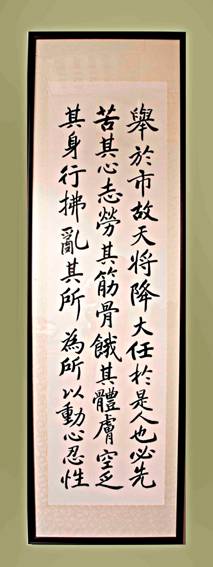
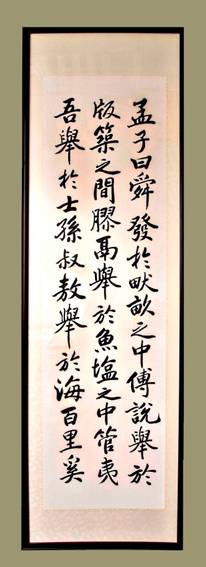
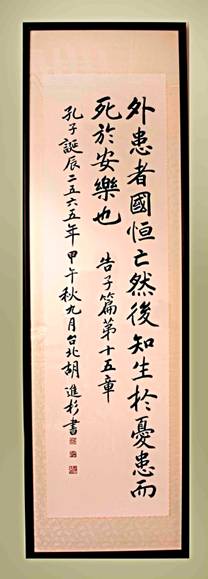
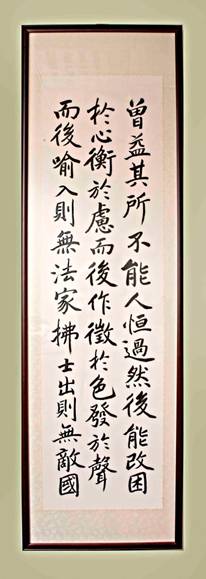
唐楷 孟子 告子篇下 第十五章 孟子曰:「舜發於畎畝之中,傅說舉於版築之間,膠鬲舉於魚鹽之中,管夷吾舉於士,孫叔敖舉於海,百里奚舉於市。故天將降大任 於是人也,必先苦其心志,勞其筋骨,餓其體膚,空乏其身,行拂亂其所為,所以動心忍性,曾益其所不能。人恒過,然後能改;困於心,衡於慮,而後作;徵於色,發於聲,而後喻。入則無法家拂士,出則無敵國外患者,國恒亡。然後知生於憂患而死於安樂也。」
Regular Script (kaishu) The Mencius, Kaou-Tsze. Part II. XV. Mencius said, “Shun rose from among the channeled fields. FOO Yueh was called to office from the midst of his frames and beaters; JYAO Ger from his fish and salt; KWAN E-woo from the hands of the officer in charge of him; SUN Shuh-Ao from the sea-shore; and BAI-LI Xi from the market-place. Thus, when Heaven is about to confer a great office on any one, it first exercises his mind with suffering, and his sinews and bones with toil; it exposes his body to hunger, and subjects him to extreme poverty; and it confounds his undertakings. In all these ways it stimulates his mind, hardens his nature, and supplies his incompetency. Men constantly err, but are afterwards able to reform. They are distressed in mind, and perplexed in thought, and then they arise to vigorous endeavor. When things have been evidenced in men’s looks, and set forth in their words, then they understand them. If a ruler has not about his court families attached to the laws and able officers, and if abroad there are no hostile States or other external calamities, the State will generally come to ruin. From such things we see how life springs from sorrow and calamity, and death from ease and pleasure.” |
24 inches x 78 inches (each)
24 inches x 78 inches (each) |
|
|
※ ※ ※ 唐楷:唐朝(618-907 AD)在楷書方面的成就最為後世推崇,字體以法度嚴謹著稱,在中國書法史上與秦篆與漢隸並列。 The Regular Script (kaishu) is considered to have matured stylistically during the Tang Dynasty (618-907 AD). It is famous for the strictness and clearness of its strokes. In Chinese calligraphy, the Regular Script of the Tang Dynasty ranks alongside the Small Seal Script of the Qin Dynasty (221-206 BC) and the Clerical Script of the Han Dynasty (206 BC-220 AD).
孟子(前372年-前289年)名軻,鄒國(今山東鄒縣)人。東周戰國時期儒家代表人物,孟子之弟子萬章與其餘弟子著有《孟子》一書。繼承並發揚了孔子的思想,成為僅次於孔子的一代儒家宗師,有「亞聖」之稱,與孔子合稱為「孔孟」。 Mencius (372 – 289 BC) was a Chinese philosopher who is the most famous Confucian after Confucius himself. During the Warring States period (403–221 BC), Mencius served as an official and scholar at the Jixia (稷下) Academy in the State of Qi (1046 - 221 BC) from 319 to 312 BC. He expressed his filial devotion when he took three years leave of absence from his official duties for Qi to mourn his mother's death. Disappointed at his failure to effect changes in his contemporary world, he retired from public life. He is called ‘The Second Sage’ posthumously. The Mencius, commonly called the Mengzi, is a collection of anecdotes and conversations of the Confucian thinker and philosopher Mencius (372 -289 BC). The work dates from the second half of the 4th century BC.
白話譯文 孟子說:舜從田間勞動中出身,傅說從築牆的土木工中被拔舉,膠鬲從魚鹽的買賣中被發掘推舉,管仲獲拔擢前是個囚徒,孫叔敖出身艱困的討海生活,百里奚原來是奴役市場被賣身的奴僕。所以,上天將要把重大使命降落到某人身上,一定要先使他的意志受到磨練,讓他的筋骨受到勞累,要他的身體忍飢挨餓,使他備受困苦,做事總是不能順利。這樣來提振他的心志,堅韌他的性情,增長他的才能。人總是要經常犯錯誤,然後纔能改正錯誤;心氣鬱結,殫思極慮,然後纔能奮發而起;顯露在臉色上,表達在聲音中,然後纔真正領悟及瞭解了。一個國家,內没有堅守執法的大臣和誠心輔佐並疾言直諫的賢士,外没有敵國憑凌的憂患,則常常是容易亡國的。由此可以知道,憂患使人生存,安逸享樂卻使人敗亡。 |
|
14 |
唐楷 崔顥 行經華陰 岧嶢太華俯咸京,天外三峰削不成。
Regular Script (kaishu) Passing Huayin CUI Hao (704-754 AD) Overlooking Capital Xianyang the majestic Hua Ridge towers high; Three divine peaks, not carved by mortals, point to the sky, Facing Emperor Wu’s mausoleum, clouds are about to disperse. Over the peaks of the Fairy’s Palm, the sky clears after rain.
Along the dangerous northern corridor the rivers and mountains rest. Leading to the Altar of Han, the wide road stretches westward. May I ask those seeking fame and wealth, Why not stay and learn the art of the immortal way? |
34.7 inches x 69 inches |
|
|
※ ※ ※ 唐楷:唐朝(618-907 AD)在楷書方面的成就最為後世推崇,字體以法度嚴謹著稱,在中國書法史上與秦篆與漢隸並列。 The Regular Script (kaishu) is considered to have matured stylistically during the Tang Dynasty (618-907 AD). It is famous for the strictness and clearness of its strokes. In Chinese calligraphy, the Regular Script of the Tang Dynasty ranks alongside the Small Seal Script of the Qin Dynasty (221-206 BC) and the Clerical Script of the Han Dynasty (206 BC-220 AD).
崔顥(704-754 AD),汴州(今河南開封)人。唐玄宗開元十一年(723 AD)登進士第。少年時詩多寫閨情,後至邊塞任職,詩風轉為雄渾奔放。 CUI Hao (704 -754 AD), born in Bianzhou (now Kaifeng, Henan Province), passed the highest level of the imperial examinations at the age of 19. In his youth, CUI’s poetry was imbued with passion and romance. After being assigned to a frontier fortress, he began to write with even greater unrestraint and ebullience.
華陰:地在華山之北。中國傳統以山南為陽,山北為陰;水北為陽,水南為陰。 故淮陰自在淮河之南,而衡陽因在衡山之南而名。 Huayin is a city located on the north side of Hua Ridge. Traditionally, the Chinese regarded the southern side of a mountain and northern side of a river as “yang,” and the northern side of a mountain and southern side of a river as “yin.” By the same token, Huaiyin is located on the south side of Huai River, and Hengyang is on the south side of Heng Ridge.
白話譯文
巍峩的華山,俯視這京城咸陽。插入天外鬼斧神工般的三座巨峰,不是人工可以做成。 |
|

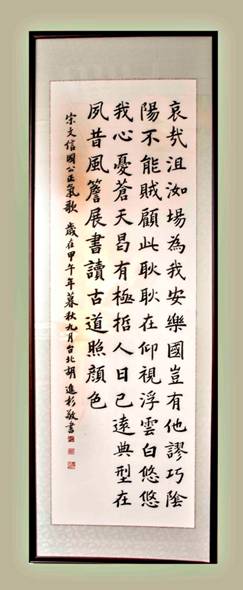
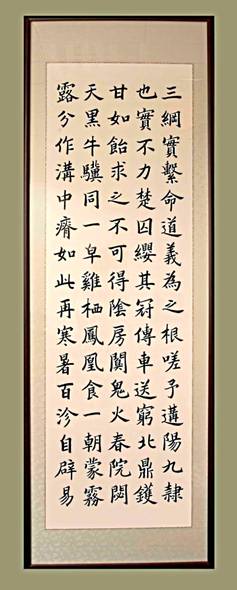
15 |
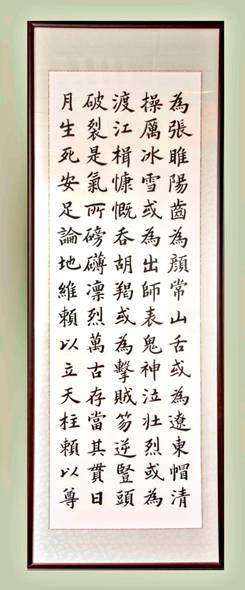
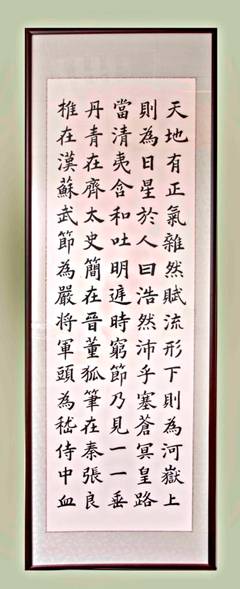
唐楷 文天祥 正氣歌 天地有正氣,雜然賦流形。 下則為河嶽,上則為日星。 於人曰浩然,沛乎塞蒼冥。 皇路當清夷,含和吐明庭。 時窮節乃見,一一垂丹青。 在齊太史簡,在晉董狐筆。 在秦張良椎,在漢蘇武節。 為嚴將軍頭,為嵇侍中血。 為張睢陽齒,為顏常山舌。 或為遼東帽,清操厲冰雪。 或為出師表,鬼神泣壯烈。 或為渡江楫,慷慨吞胡羯。 或為擊賊笏,逆豎頭破裂。 是氣所磅礡,凜烈萬古存。 當其貫日月,生死安足論。 地維賴以立,天柱賴以尊。 三綱實繫命,道義為之根。 嗟予遘陽九,隸也實不力。 楚囚纓其冠,傳車送窮北。 鼎鑊甘如飴,求之不可得。 陰房闃鬼火,春院閟天黑。 牛驥同一皂,雞棲鳳凰食。 一朝蒙霧露,分作溝中瘠。 如此再寒暑,百沴自辟易。 哀哉沮洳場,為我安樂國。 豈有他繆巧,陰陽不能賊。 顧此耿耿在,仰視浮雲白。 悠悠我心悲,蒼天曷有極。 哲人日已遠,典型在夙昔。 風簷展書讀,古道照顏色。
Regular Script (kaishu) WEN Tianjiang(1236-1283 AD) Integrity is embodied in various forms. On earth it is the mountains and rivers; in the sky it is the sun and stars. In man it is the noble spirit that fills up the whole world. The whole empire is in tranquility, all courtiers serve harmoniously in the royal court. When the nation is threatened, the courtier’s high moral principle shows itself; and leaves its record in history. This is revealed in the records of Qi, the writings of DONG Hu of Jin. ZHANG Liang’s service to Qin and SU Wu’s moral courage in the Han Dynasty. It was General YAN’s head, JI Kang’s blood, ZHANG Suiyang’s teeth, and YAN Changshan’s tongue. It was the Liaodong hat that could withstand ice and snow. It was ZHUGE Liang’s heroic memorial which moved immortals. It was the river-crossing oar that wiped out the nomad invaders. It was the hand scepter that crushed treacherous vassals’ heads. Integrity is so majestic that it will never die out. It shoots up to the sun and the moon, and life and death are of no importance before it. It supports both the earth and the sky. Our lives hinge on our cardinal guides and our foundation rests on our morality. But now everything is upside down; a courtier could not serve the nation. Divested of his headgear this prisoner is kept behind bars in the north. He would be only glad to be burned in the barbarians’ crucible. Ghost flame rages in the room and the courtyard is wrapped in darkness. Oxen and steeds live in the same fold and chickens and phoenixes share the same food. Once you got sick, carcass to dump in the drench, I survived under these adversities for two years, All sickness ad diseases could not infringe me, I am sad that this swamp used to be my paradise-like homeland. Do I have tricks to ward off diseases? Yin and yang are not to be confused. Because my serene and loyal spirit firmly support me. So I can still clearly look up at the white clouds floating in the sky. My heart is full of sorrow for my nation, and I wonder where the sky will end. The ancient sages are far away, But their exemplary deeds still shine. I open a book to read under the windy gable, splendor reflected on my face. |
28.8 inches x 82.2 inches (each)
28.8 inches x 82.2 inches (each) |
|
|
※ ※ ※ 唐楷:唐朝(618-907 AD)在楷書方面的成就最為後世推崇,字體以法度嚴謹著稱,在中國書法史上與秦篆與漢隸並列。 The Regular Script (kaishu) is considered to have matured stylistically during the Tang Dynasty (618-907 AD). It is famous for the strictness and clearness of its strokes. In Chinese calligraphy, the Regular Script of the Tang Dynasty ranks alongside the Small Seal Script of the Qin Dynasty (221-206 BC) and the Clerical Script of the Han Dynasty (206 BC-220 AD).
文天祥(1236-1283 AD),南宋(1127-1279 AD)末期吉州廬陵(今江西吉安縣)人。文天祥與元世祖忽必烈(1215-1294 AD)談判,提出隱居深山的條件,忽必烈提出的條件是降元為官或處死,文天祥選擇處死,與陸秀夫(1236-1279 AD)和張世傑(?-1279 AD)並稱「宋末三傑」。 WEN Tianxiang (1236-1283 AD) was a scholar-general in the final years of the Southern Song Dynasty (1127-1279 AD). His infamous resistance to the invasion of the Song by Kublai Khan (1215-1294 AD) and staunch refusal to yield to the Yuan Dynasty (1271-1368 AD) despite being captured and tortured credits him as a symbol of patriotism and righteousness in China. WEN is considered one of three heroes of the Song Dynasty's last years, alongside LU Xiufu and ZHANG Shijie.
白話譯文 天地間存在著一股沛然正氣,散佈在各種事務及物體: 在地上就是浩蕩崇高的江河山嶽,在天上就是燦爛光輝日月星辰, 在人身上的就是那種浩然正氣,恢弘盛大地充滿在天地間。 當國家太平的時候,為人臣者都含蘊著和順之氣,盡心國事於盛明的朝廷中; 一旦時局艱難,忠臣的節義就開始表現出來,而逐一的記載在史冊: 在齊國有前仆後繼的太史犧牲性命,忠實記錄「崔抒其弒君」的簡冊; 在晉國有董狐不畏權勢,直書「趙盾弒其君」的史筆; 在秦朝,有張良義動大力士、狙擊暴君的鐵椎; 在漢朝,有蘇武出使匈奴、牧羊北海所持的符節; 東漢時,有寧可斷頭也不願投降的嚴顏將軍; 有侍中嵇紹以身護衛晉惠帝,而濺在帝衣上的忠烈血; 有死守睢陽的張巡,恨不吞滅逆賊的碎齒; 有常山太守顏杲卿,罵賊而遭割斷的舌頭; 東漢時著黑帽布衣隱居遼東的管寧,他的節操比冰雪還要堅貞潔白; 三國時代寫〈出師表〉的諸葛亮,他的壯烈感泣鬼神; 東晉的祖逖,領軍渡江北伐,立誓要殲滅入侵的胡人; 唐朝的段秀實,奪笏擊打叛賊朱泚,使逆賊頭破血流。 廣大充沛的浩然正氣,嚴正肅然地長存在宇宙之間。 當它的氣魄貫通日月時,個人的生死豈值得計較? 地角因為它而永久穩固,天柱依賴它而得以高聳, 君臣,父子,夫婦的人倫綱常中有了它,纔能維繫不墜,而道義正就是這個正氣的根本。 可嘆的是我遭遇困頓的時局,現在國家被滅了,實在是我這個臣子為國家竭盡心力還不夠啊! 倉促之間成了俘虜,被關進驛車押送到極北的大都。 我即使被烹煮而死,也會當做像喝瓊漿一樣的甘美。我雖祇求一死,卻不能如願啊! 陰暗寂靜的囚房裡,處處閃著鬼火;雖在春天,深鎖的牢院,白晝也如同黑夜。 把我和其他囚犯關在一起,就好比千里馬與牛同槽共食、野雞與鳳凰一同棲息飲食。 一旦升病,我預料死後將會被棄置在溝壑中,任其腐爛。 像這樣經過了兩年,各種惡氣自行退避。 唉!這塊低溼的地方,竟然成為我的安樂世界! 難道我還有其他妙法抵抗陰陽寒暑的侵襲? 我自認有一顆光明坦蕩的心,忠誠不渝,把人生看如瞬息萬變的浮雲罷了。 無盡的憂思,何時能終結!蒼天啊蒼天!要苦難到何時! 古聖先賢雖已遠去,但是他們的模範與榜樣永遠留在人間。 吹著北風的屋簷下我展讀聖賢典籍,他們的道義風範如在眼前,他們的光芒也照在我的臉上。 |
|
|
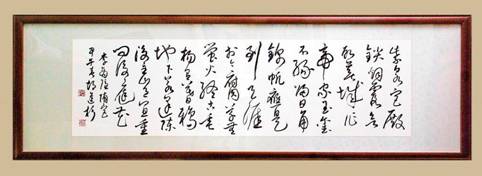
16 |
草書 李商隱 隋宮 紫泉宮殿鎖煙霞,欲取蕪城作帝家,
Cursive Script (caoshu) The Palace of the Sui Dynasty Li Shangyin (813-858 AD) The Palace of Sui has soared and been absorbed in the clouds, Emperor Suiyang desires to relocate his Capital to Yangzhou. Had the Imperial Seal not been seized by the Prince of Tang, Sui’s brocaded boat could have sailed to every corner of China. Now fireflies flying in rotten meadows disappear; to the ancient willow trees crows still return at sunset. Should he meet the dethroned Emperor Chen in the netherworld, would it be appropriate for him to even mention the song Harem Flowers? |
65.5 inches x 21 inches |
|
|
※ ※ ※ 草書:漢初,為減省或連綴隸書的筆畫,開始出現了隸書的草書,由於漢章帝(57-88 AD)喜好草書,因此被稱為章草,特點是字字獨立。後來楷書出現,逐漸出現楷書的草書,書寫迅速,往往上下字相連,稱為今草。到了唐朝,草書成為書法藝術,也演變出了「狂草」。 孫過庭(648-703 AD)《書譜》:http://www.npm.gov.tw/exh92/treasure/chinese/pic/t2-1.htm 及其釋文 http://www.npm.gov.tw/exh92/treasure/chinese/pic/t2-3.htm 狂草,唐懷素(錢藏真737-799 AD)《自敘帖》:http://www.npm.gov.tw/exh100/treasures/cn/images/img6_5s.jpg The Cursive Script (caoshu) functions primarily as a kind of shorthand script or calligraphic style. Developed during the Han Dynasty (206 BC-220 AD) as a cursory way to write the popular Clerical Script, the cursive way of writing was favored by Emperor Zhang (57-88 AD) of the Eastern Han Dynasty (25-220 AD) and called zhangcao. The characters of the Cursive Script are written closely and linked together. With the emergence of the Regular Script from theWei Kingdom (220-265 AD) to the Jin Dynasty (265-420 AD), the Modern Cursive (jincao) was developed. Apart from the Clerical Cursive and the Modern Cursive styles, there is also the Wild Cursive (kuangcao) style which developed in the Tang Dynasty (618-907 AD) and became exclusively an art form. Please refer to: “On Calligraphy” by SUN Guoting (648-703 AD): http://www.npm.gov.tw/exh92/treasure/chinese/pic/t2-1.htm As in modern print font http://www.npm.gov.tw/exh92/treasure/chinese/pic/t2-3.htm “Autobiography” by Huaisu (CHIEN Cangzhen, 737-799 AD): http://www.npm.gov.tw/exh100/treasures/cn/images/img6_5s.jpg
李商隱(813-858 AD),字義山,自號玉谿生,懷州(今河南沁陽)人。中國詩史上最唯情的詩人。時代環境的壓力及錯亂反常的命運造成他悲劇性的性格,才氣超乎常人,感情豐富細膩,詩中多呈現淒美之的魅力。由於極為關心現實和國家命運,現存約六百首詩中,有關時政的詩佔了六分之一。 LI Shang-yin (813-858 AD), born in Huaizhou (now Xinyan, Henan Province), was one of the most passionate poets in the history of Chinese literature. LI’s tragic character was formed out of the pressure of his living environment and his deranged fate. Being a talented and passionate poet, LI often conveyed charming pathos in his poems. His concern about the fate of the state is seen in that one sixth of his 600 poems focus on the politics of his time.
陳後主:(陳叔寶553-604 AD)南北朝時陳朝末代皇帝,在位七年(583-589 AD)。性淫逸、縱酒、好做艷辭,不理朝政,亡於隋。 Dethroned Chen Emperor, CHEN Shubao (553-604 AD) was the last emperor of the Chen Dynasty. During his reign he indulged himself in women and wine, ignoring state affairs. He was dethroned by the Sui Dynasty. Harem Flowers is one of his most infamous songs of lust.
白話譯文
在長安城的隋宮,鎖閉在籠罩的煙霞之中;隋煬帝卻想把遙遠的揚州作為帝業基地。 |
|
|
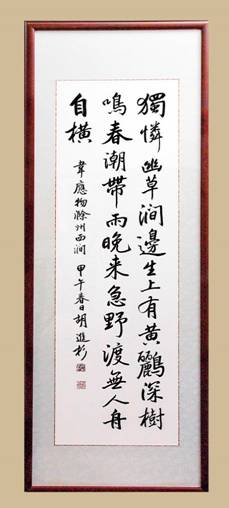
17 |
行書 韋應物 滁州西澗 獨憐幽草澗邊生,上有黃鸝深樹鳴。 春潮帶雨晚來急,野渡無人舟自橫。
Running Script (xingshu) At Chuzhou on the Western Stream WEI Yingwu (737-791 AD) I only like the tender grasses that spread along the stream, where trills of orioles echo in the forest’s deep shade. The downpour of last night’s rain hastens the speed of floods, an unguarded ferryboat docks at the water near the ferry. |
20.4 inches x 58 inches |
|
|
※ ※ ※ 行書:介於楷書及草書間的一種字體。楷書的草化,或草書的楷化。一說是在東漢(25-220 AD)年間劉德升(生卒年不詳)所創。 王羲之(303-361 AD)《蘭亭集序》、顏真卿(709-785 AD)《祭侄文稿》、蘇軾(1037-1101 AD)《寒食帖》並稱三大行書,真跡現皆存藏於中華民國國立故宮博物院,相關網站如下: 祭侄文稿:http://www.npm.gov.tw/exh97/chintang/cht_image5.html 寒食帖:http://www.npm.gov.tw/zh-tw/Article.aspx?sNo=04001005 The Running Script (xingshu) is a style of calligraphy containing elements of both the Regular Script and Cursive Script styles. Legend has it that the Running Script was founded by LIU De-sheng (birth and death unknown) during the Eastern Han Dynasty (25-220 AD). All of the best and representative manifestations of Running Script writings-i.e., “The Orchid Pavilion Preface” by WANG Xizhi (303-361 AD), “Draft of Eulogy to My Nephew” by YEN Zhenqing (709-785 AD), and “The Cold Food Observance” by SU Shi (1037-1101 AD)-are preserved at the National Palace Museum in Taipei, Republic of China (Taiwan). The linked web pages are as follows: Draft of Eulogy to My Nephew: http://www.npm.gov.tw/exh97/chintang/cht_image5.html The Cold Food Observance: http://www.npm.gov.tw/zh-tw/Article.aspx?sNo=04001005
韋應物(737-792 AD),長安杜陵人(今陜西省西安)。曾任蘇州刺史。一生嚮往山野林泉,故詩作多描寫田園風物,詩風淡泊樸實、高雅空靈。山水詩中亦不乏雄豪氣勢。 WEI Ying-wu (737-792 AD) was born in Duling, Changan (now Xian, Shanxi Province). Formerly serving as the Suzhou magistrate, WEI greatly loved his beautiful and idyllic surroundings, which are reflected in his graceful poetry. Lyrical and elegant, his shan shui (mountain and stream) poetry contains an air of heroic grandeur.
白話譯文 獨獨憐愛澗邊生長的幽幽小草,樹陰深處黃鶯自得的啼鳴。 前晚的春雨使潮水漲得更急,郊野渡口上,没人看顧的渡船兀自橫泊在河裏。 |
|
18 |
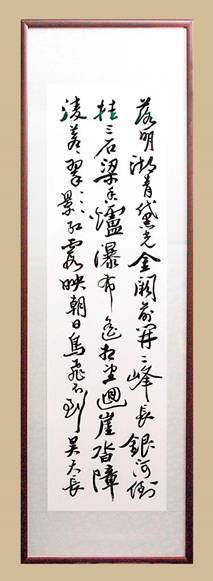
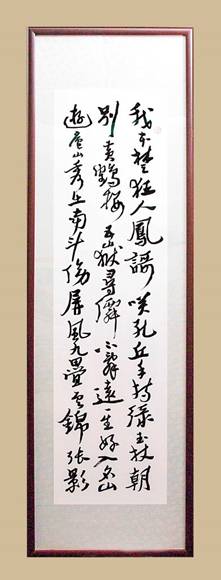
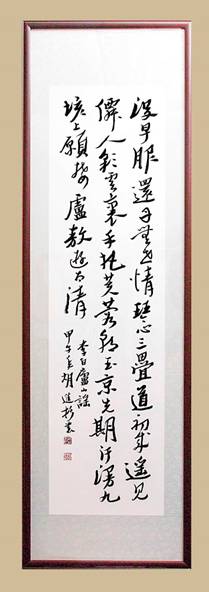
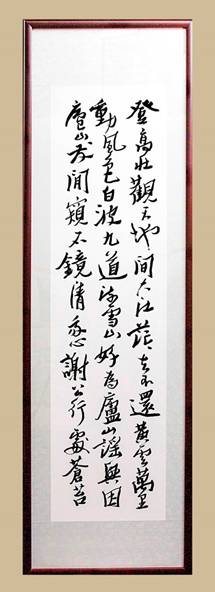
行草 李白 廬山謠寄盧侍御虛舟 我本楚狂人,鳳歌笑孔丘。 手持綠玉杖,朝別黃鶴樓。 五嶽尋仙不辭遠,一生好入名山遊。 廬山秀出南斗旁,屏風九疊雲錦張,影落明湖青黛光。 金闕前開二峰長,銀河倒挂三石梁。 香爐瀑布遙相望,迴崖沓障凌蒼蒼。 翠影紅霞映朝日,鳥飛不到吳天長。 登高壯觀天地間,大江茫茫去不還。 黃雲萬里動風色,白波九道流雪山。 好為廬山謠,興因廬山發。 閒窺石鏡清我心,謝公行處蒼苔没。 早服還丹無世情,琴心三疊道初成。 遙見仙人彩雲裏,手把芙蓉朝玉京。 先期汗漫九垓上,願接盧敖遊太清。
Semi-Cursive Script (xingcao) poem A Song of Lu Ridge to Ombudsman LU Xuzhou LI Bai (701-762 AD) I am the lunatic of the Chu State who sings a satire ridiculing Confucius. In my hand I hold a cane of green jade, and bid farewell to the morning at the Yellow Crane Tower. Visiting the five Mounts without worry of its distance, such is my incorrigible habit of searching for fairies. The Lu Ridge stands beside the South Dipper, the Nine-panels enshrouded in gorgeous clouds of brocade, the image of the summit reflecting off of a turquoise lake. The Golden Gate opens into two steep mountains. A silver waterfall streams down to the three stone bridges, within sight of the remote Incense Burner Falls. Overlapping ledges of cliff and winding trails lead the way to the sky. Magnificent are the sunrise scarlet clouds reflecting off the blue mountains. The Wu sky is vast when viewed from the summit.
Climbing to the top of the Lu Ridge to survey the whole world, I see the Yangtze River running to the point of no return. The oscillations of yellow clouds float thousands of miles, The scenery on the river banks changes constantly, snow-like waves swirl in the nine streams of the Yangtze River. I am singing a song dedicated to the Lu Ridge, my desire to write poems is inspired by the Lu Ridge. Looking at the Stone Mirror makes my heart serene. Green moss has covered the footsteps of Master Xie. I have taken the immortal elixirs and feel unattached to mundane chores. Before the lute’s third song, I have achieved my fairyhood. I watch as distant immortals ride the colored clouds toward Heaven’s Jade Palace with lotus flowers clasped between their hands. And so, once I have traversed the ninth heaven of Paradise, may we tour the Great Purity (Paradise) together. |
20.2 inches x 68.6 inches (each)
20.2 inches x 68.6 inches (each) |
|
|
※ ※ ※ 行草:介於行書與草書之間的字體,比行書潦草,但較草書易於辨識。 米芾(1051-1107 AD)蜀素帖:http://www.npm.gov.tw/exh100/treasures/cn/img6_6.html 王鐸(1592-1652 AD)草書:http://www.npm.gov.tw/zh-TW/Article.aspx?sNo=04001018 The Semi-Cursive Script (xingcao) is a cursive style derived from the Clerical Script. Its form is not as shortened as seen in the Cursive Script, but appears with greater fluidity compared to the Running Script. Most people who can read the Regular Script can also read the Semi-Cursive Script. “On Sichuan Silk” by MI Fu (1051-1107 AD): http://www.npm.gov.tw/exh100/treasures/cn/img6_6.html Semi-Cursive Script by WANG Duo (1592-1652 AD): http://www.npm.gov.tw/zh-TW/Article.aspx?sNo=04001018
李白(701-762 AD),生於西域碎葉城(今吉爾吉斯共和國吐克馬克),字太白,幼年遷居蜀郡青蓮鄉(今四川省江油縣內),故號青蓮居士。杜甫(712-770 AD)稱李白的詩作有「筆落驚風雨,詩成泣鬼神」的藝術魅力。有「詩仙」之稱的李白一生作品極多,現存詩九百餘首。許多詩作不論老少都可琅琅上口,對後代影響深遠。 傳說他在舟中醉酒賞月,欲撈水中月而死。詩歌創作題材廣泛,加以一生際遇起伏,早年與晚年詩風大為不同。 LI Bai (701-762 AD), also known as LI Tai-bai, was born in Xueiye (now Tokmak, Kyrgyzstan). In his childhood, he moved to Qing-lian Village, Shu Province (now Jiangyou County, Sichuan Province). His poems have such artistic charm that, in the words of his contemporary poet DU Fu (712-770 AD), “strokes of his pen generate storms, and the completion of a poem moves even gods and ghosts.” Dubbed the “fairy poet,” over 900 poems have been preserved from his prolific writing. Many of his poems have stood the test of time and are well appreciated by both young and old. Stories about LI Bai’s death vary significantly. One story suggests that his death was precipitated one evening when he tried to catch the reflected moon in the water. The inebriated LI drowned instead. Reflective of the fate of life’s ups and downs, LI’s poetic style and subjects varied widely throughout the early and late part of his life.
白話譯文 我本是楚國的狂人,高唱鳳歌譏笑孔丘。 手執綠玉做的枴杖,早晨我辭別黃鶴樓。 為著尋仙,我不辭遙遠地遍訪五嶽,平生中,我最愛好到名山去遨遊。 廬山高聳,與天上的南斗星靠近,五老峰的九疊屏,好像雲霞展開,那墨綠色的山影湖光相映襯,綺麗俊秀。 金闕前香爐峰和雙劍峰,高聳對峙,三石樑的瀑布,恰似銀河倒掛飛流。 香爐峰的瀑布,與此遙遙相望,峻崖環繞,峰巒重疊直至天上。 蒼翠的山色映著朝陽,紅霞更加絢麗,在鳥飛不到的峰頂,俯視著如天般長的寬廣吳地。 登上廬山縱覽天地,纔領略天地壯觀,俯瞰茫茫長江東流,永去不還。 萬里黃雲起伏,景色不斷變幻,長江九條支流,翻滾著雪山般的白浪。 愛做讚美廬山的歌謠,詩興都因廬山所觸發。 閒對石鏡峰窺看,我更加心清意暢,謝靈運當年遊處,早已被青苔掩藏。 我早就服了還丹,對世俗毫無情念,修練到心和神悅的境界,就覺得仙道已經初成。 向遠處看去,仙人們正駕馭著彩雲,手捧芙蓉到玉京山,去朝拜天尊。 我早與汗漫仙人,相約在九天之頂,心想接你這位盧敖,一起往太清同遊。 |
|
19 |
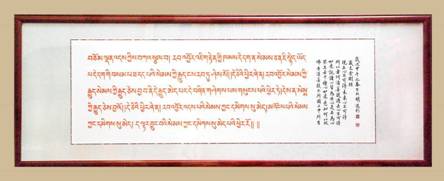
藏文 金剛經 第十八分 佛告須菩提,爾所國土中,所有眾生若干種心,如來悉知。何以故。如來說諸心皆為非心,是名為心。所以者何。須菩提,過去心不可得,現在心不可得,未來心不可得。
Tibetan Script (zhangwen) with original Han Script (hanwen) The Diamond Sutra, Chapter 18 The Buddha said to Subhuti: “I know the mind of every living being in all the host of universes, regardless of any modes of thought, conceptions or tendencies. For all modes, conceptions and tendencies of thought are not the mind. And yet they are called the mind. Why? It is impossible to retain a past thought, to seize a future thought, and even to hold onto a present thought.” |
58 inches x 20.5 inches |
|
|
※ ※ ※ 金剛經:佛教一部很重要的經典,對中華文化與禪宗有著鉅大的影響。整部經的要旨在闡述宇宙萬法皆假因緣和合而生,緣聚則生,緣散則滅,故空無實體,以此令眾生了悟諸法無我、諸行無常之理,進而能去除對世間一切相的執著,過著無住的生活得解脫自在。另一方面說明般若智慧人人本具,不假外求,祇能向內心去挖掘。 從《金剛經》中可以如實了知,佛教是以人為本的人間佛教,修行是在日常生活中修,離開生活也就没有「般若」,也就無法了解「空」理了。 20世紀初出土於敦煌的《金剛經》,印於唐懿宗(859-873 AD)咸通九年(868 AD),為現存世界最早的印刷品之一,藏於大英圖書館。其較古騰堡於1455年在德意志採用活字印刷術印刷的《古騰堡聖經》大約早587年。 請參見:http://lib.ihp.sinica.edu.tw/pages/03-rare/dunhuang/01-1.htm或http://idp.bl.uk The Diamond Sutra is one of the most important Buddhist sutras (scriptures). It has tremendous influence on Chinese culture and in Zen Buddhism. The theme of the sutra lies in revealing the fact that all phenomena and everything in the universe are created and terminated according to previous causes or chance meetings of certain circumstances. Nothing has a fixed nature in its own right. As a result, we can therefore realize the fundamental principles that nothing lasts forever and there is no “I.” Furthermore, people can lead an unencumbered and carefree life by removing all sorts of attachments. On the other hand, the sutra also illustrates that everyone has the intrinsic Prajñāpāramitā, or “Perfection of Wisdom” which does not require outward searching. It exists right in our hearts. The sutra clearly shows that the core of Buddhist philosophy is to humanize Buddhism, and we should cultivate our spirituality in daily life. There will be no Prajñā (Wisdom) if we fail to cultivate and practice it in daily life, and we certainly will not be able to comprehend the true meaning of “void.” A copy of the Chinese version of The Diamond Sutra, found among the Dunhuang manuscripts in the early 20th century by Aurel Stein, dates back to May 11, 868 AD. It is, in the words of the British Library, “the earliest complete survival of a dated printed book.” This is approximately 587 years before the Gutenberg Bible was first printed in Germany in 1455. Please visit: http://lib.ihp.sinica.edu.tw/pages/03-rare/dunhuang/01-1.htm or http://idp.bl.uk
白話譯文 佛對須菩提說:(不必遠說多如恆河沙的其他世界,就即便是)近在你的國土中,所有人的心,隨情而遷,逐境而生,顛倒妄想,各有所思,種種不一,如來我皆盡見盡知。這是什麼緣故呢﹖因為通常所說的一切心,皆祇是眾生的妄心,不是本性中常住的真心,瞭解了不是妄心的心,纔能展現出菩提的本體,纔可以稱之為心。什麼緣故呢﹖須菩提!我所說的非心,是常住的真心,寂然不動,物至則覺。過往没有什麼留滯而不去的心,現在没有什麼執著而永遠銘記的心,而對未來也没有什麼預期而憧憬的心。(反觀於內,則三心總不可得。知其不可得,則清清淨淨的般若現出,所謂人心淨而道心生,這纔是菩提的真心。) |
|
20 |
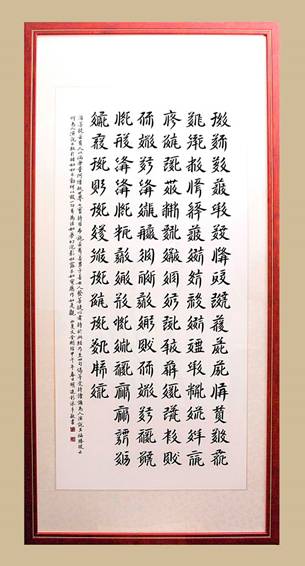
西夏文 金剛經 第三十二分 須菩提!若有人以滿無量阿僧祇世界七寶,持用布施。若有善男子、善女人,發菩提心者,持於此經,乃至四句偈等,受持、讀誦,為人演說,其福勝彼。云何為人演說?不取於相,如如不動。何以故?一切有為法,如夢幻泡影;如露亦如電,應作如是觀。
West Xia Regime (1032-1227 AD) Script (xixiawen) with original Han Script (hanwen) The Diamond Sutra, Chapter 32 The Buddha said to Subhuti: “If anyone gave to the Buddha an immeasurable quantity of the seven treasures sufficient to fill the whole universe; and if another person, whether a man or a woman, in seeking to attain complete Enlightenment were to earnestly and faithfully observe and study even a single verse of this Sutra and explain it to others, the accumulated blessing and merit of that latter person would be far more. Subhuti, how can one explain this Sutra to others without holding in mind any arbitrary conception of forms or phenomena or spiritual truths? It can only be done, Subhuti, by keeping the mind in perfect tranquility and free from any attachment to appearances. So
I say unto you— Like
a tiny drop of dew, or a bubble floating in a stream; Or an illusion, a phantom, or a dream. So is all conditioned existence to be seen.”
|
65.6 inches x 24 inches |
|
|
※ ※ ※ 西夏(1038-1227 AD):為原居四川松潘高原的黨項族所建,唐朝(618-907 AD)時遷居陝北。先後臣服於唐朝、五代諸朝(897-979 AD)與宋朝(960-1279 AD)。金朝(1115-1234 AD)崛起並滅遼(916-1225 AD)、北宋(960-1127 AD)後,與西夏建立同盟。蒙古帝國(1206-1259 AD)崛起,六次入侵西夏, 於公元1227年亡於蒙古。 The West Xia Regime (1038-1227 AD) inherited the political and social structures of the Tang Dynasty (618-907 AD), further developing an already outstanding civilization. Their territory encompassed the present Ningxia, Gansu, eastern Qinghai, and northern Shaanxi region, covering approximately 310,000 square miles. In the beginning of the thirteenth century, Genghis Khan (1162-1227 AD) unified the northern grasslands of Mongolia and led the Mongol troops to carry out six rounds of attacks against the West Xia Regime. After the West Xia capital was overrun in 1227 AD, the Mongols annihilated its architecture and written records.
金剛經:佛教一部很重要的經典,對中華文化與禪宗有著鉅大的影響。整部經的要旨在闡述宇宙萬法皆假因緣和合而生,緣聚則生,緣散則滅,故空無實體,以此令眾生了悟諸法無我、諸行無常之理,進而能去除對世間一切相的執著,過著無住的生活得解脫自在。另一方面說明般若智慧人人本具,不假外求,祇能向內心去挖掘。 從《金剛經》中可以如實了知,佛教是以人為本的人間佛教,修行是在日常生活中修,離開生活也就没有「般若」,也就無法了解「空」理了。 20世紀初出土於敦煌的《金剛經》,印於唐懿宗(859-873 AD)咸通九年(868 AD),為現存世界最早的印刷品之一,藏於大英圖書館。其較古騰堡於1455年在德意志採用活字印刷術印刷的《古騰堡聖經》大約早587年。 請參見:http://lib.ihp.sinica.edu.tw/pages/03-rare/dunhuang/01-1.htm或http://idp.bl.uk The Diamond Sutra is one of the most important Buddhist sutras (scriptures). It has tremendous influence on Chinese culture and in Zen Buddhism. The theme of the sutra lies in revealing the fact that all phenomena and everything in the universe are created and terminated according to previous causes or chance meetings of certain circumstances. Nothing has a fixed nature in its own right. As a result, we can therefore realize the fundamental principles that nothing lasts forever and there is no “I.” Furthermore, people can lead an unencumbered and carefree life by removing all sorts of attachments. On the other hand, the sutra also illustrates that everyone has the intrinsic Prajñāpāramitā, or “Perfection of Wisdom” which does not require outward searching. It exists right in our hearts. The sutra clearly shows that the core of Buddhist philosophy is to humanize Buddhism, and we should cultivate our spirituality in daily life. There will be no Prajñā (Wisdom) if we fail to cultivate and practice it in daily life, and we certainly will not be able to comprehend the true meaning of “void.” A copy of the Chinese version of The Diamond Sutra, found among the Dunhuang manuscripts in the early 20th century by Aurel Stein, dates back to May 11, 868 AD. It is, in the words of the British Library, “the earliest complete survival of a dated printed book.” This is approximately 587 years before the Gutenberg Bible was first printed in Germany in 1455. Please visit: http://lib.ihp.sinica.edu.tw/pages/03-rare/dunhuang/01-1.htm or http://idp.bl.uk
白話譯文 佛對須菩提說:如果有人以無量無數的世界七寶廣為布施,當然多福;但比起普通的善男信女,發廣大普濟的大願,受持金剛經,不但要求自己明心見性,還到處傳布,助人能自見其性,這後一種的福報,比前一種更多。但應如何傳布呢﹖要不著相,要不動心。這是什麼緣故呢?因為凡世間,一切作為,現滅不常,如同夢境、如同幻緣、如同浮泡、如同虛影、如同朝露即乾、如同電光忽過,凡屬有為,要以領悟這六種現象的心態去觀察與認知。 |
|
|
21 |
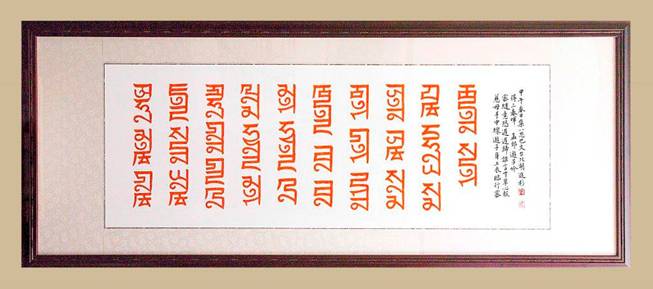
八思巴文 孟郊 遊子吟 慈母手中線,遊子身上衣。 臨行密密縫,意恐遲遲歸。 誰言寸草心,報得三春暉。
Mongolian Square Script (Phags-pa script) A Traveller’s Song MENG Jiao (751-814 AD) The thread in the hands of an amiable mother Makes clothes for the body of her wayward son; Carefully she sews and thoroughly she darns, Dreading the delays that will keep him away from home. But who says the heart of the inch-long grass Can repay the warmth of the spring sun?
|
65.6 inches x 24 inches |
|
|
※ ※ ※ 八思巴文:元世祖忽必烈(1215-1294 AD)時,國師八思巴(1238-1279 AD)根據吐蕃文而制定的文字。然當時蒙古帝國已分裂為大元和四大汗國,八思巴字祇有元朝(1279-1367 AD)採用。明朝(1368-1644 AD)推翻元朝後,八思巴字遂廢棄不用。 The Mongolian Square Script (Phags-pa Script) is a writing style designed by the Tibetan monk and vice-king, Drogön Chögyal Phags-pa (1238-1279 AD), for Emperor Kublai Khan (1215-1294 AD) of the Yuan Dynasty (1279-1367 AD). Its usage was limited to the Yuan Dynasty and later fell out of use with the advent of the Ming dynasty (1368-1644 AD).
孟郊(751-814 AD),字東野,湖州武康(今浙江德清)人。現存詩歌五百多首,以短篇的五言古詩最多,代表作即為此首《遊子吟》。 MENG Jiao (751-814 AD) was born in Huzhou (now Deqin, Zhejiang Province). Most of his 500 some poems are written in the 5-character-per-line style, amongst which A Traveller’s Song is the most famous.
白話譯文 慈祥和藹的母親拿著針線,為將要出遠門的孩子縫衣服。 |
|
|
22 |
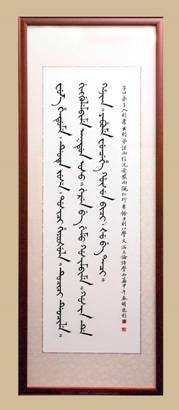
滿文 論語 學而篇 子曰:弟子入則孝,出則弟,謹而信,汎愛眾而親仁,行有餘力,則以學文。
Manchurian Script (manju hergen) of Confucius (551-479 BC) remarks with original Han Script (hanwen) The Analects, Xue-Er Chapter Confucius said: “A young man should serve his parents at home and be respectful to the elders outside his home. He should be earnest and truthful, loving towards all, and cultivating of his friendship with moral people. After all this, if there is time, he can study literature and art.” |
22 inches x 59.1 inches |
|
|
※ ※ ※ 滿文:公元1599年,清太祖高皇帝努爾哈赤(1559-1626 AD)詔命依蒙古文字創製滿文,約30年後,清太宗皇太極(1592-1643 AD)命達海(1595-1632 AD)進一步改進完善滿文。清朝(1644-1911 AD)前期,政府官文書以滿文為主,康熙(1661-1722 AD)、雍正(1678-1735 AD)起,官文書開始滿漢合璧。 The Manchurian Script (manju hergen) was derived from the Mongolian script. Nurhaci (1559-1626 AD) ordered the creation of the Manchurian script in 1599. His son, Hong Taiji (1592-1643 AD), ordered Dahai (1595-1632 AD) to further develop and enrich it. In the beginning of the Qing Dynasty (1644-1911 AD), the official writing system was only Manchurian script. Since the dominions of the Kangxi Emperor (1661-1722 AD) and the Yongzheng Emperor (1678-1735 AD), all official documents gradually started to use Manchurian and Han scripts in tandem.
論語:孔子和他的弟子及再傳弟子言行為主的匯編,是儒家重要的經典之一。 The Analects is a collection of aphorisms from Confucius, his disciples and his disciples’ disciples. It is the most important book in Confucianism.
孔子(551-479 BC),名丘,字仲尼。春秋末期魯國教育家與哲學家,曾任魯大司寇。刪詩書、訂禮樂、贊周易、著春秋,是儒學和儒家的創始人。學不厭、教不倦,使孔子成為「至聖先師」。他主張有教無類,將前此貴族所獨有之禮樂教育普及於平民,學生多至三千人。西漢武帝時,董仲舒(179-104 BC)進言罷黜百家獨尊儒術,奠定了儒家兩千年來的正統學派地位,孔子並被尊為萬世師表。 Confucius (551-479 BC) was born into a rather impoverished family of noble descent in Lu State (within modern Shantung Province). His Chinese name was KONG Chiu, with a courtesy name Zhong-ni. After resigning from his post as minister of Lu State, he travelled to many parts of China. He was, and still is, regarded as the most famous Chinese philosopher and educator. His policy was to accept any person as a disciple, provided that the student was genuinely eager to learn. This idea was revolutionary in a society in which education was the exclusive privilege of the aristocracy. He is credited with educating 3,000 students. He is also one of the first Chinese philosophers to leave behind a collection of teachings that can be reliably ascribed to his philosophy - The Analects. Confucius authored or edited the following works: Classics of Poetry, Book of Documents, Book of Rites, I Ching, and the Spring and Autumn Annals. During the reign of Emperor Wu of the West Han Dynasty (141-87 BC), the Confucian scholar and Imperial courtier DONG Zhong-Su (179-104 BC) recommended and adopted the policy to “reject other schools of thoughts, [and] respect only Confucianism.” Since then, Confucius was highly regarded as the Model for All Ages.
白話譯文 孔子說:「做一個學生,在家應當孝順父母,出外應當恭敬師長,做事應謹慎說話要誠信,對眾人要平等友愛,特別應該親近有仁德的人,如此修行還有餘力,再向書本文字上用功。」 |
|
23 A |
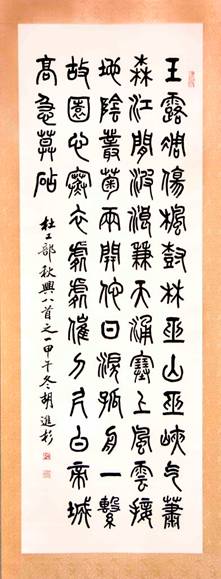
小篆 杜甫 秋興八首之一 玉露凋傷楓樹林,巫山巫峽氣蕭森。 江間波浪兼天湧,塞上風雲接地陰。 叢菊兩開他日淚,孤舟一繫故園心。 寒衣處處催刀尺,白帝城高急暮砧。
Small Seal Script (xiaozhuan) Autumn Meditation 1 DU Fu (712-770 AD) Crystal dew de-foilages maple forest, The Wu Ridge and the Wu Gorge emit bleakness. Fierce wave in the Yangtze River surge towards the distant sky, Above the pass wind and cloud join the earth with darkness. My teary eyes witnessed twice blossomed chrysanthemums. My homesick heart still moors like a lonely boat. Rushing scissors and scales making winter clothes everywhere, The anvil beating resounds from the high White Emperor Citadel at dusk. |
31.2 inches x 92.6 inches (Scroll) |
|
|
※ ※ ※ 小篆:秦始皇(260-210 BC)統一六國後,厲行書同文,由宰相李斯(280-208 BC)主政,為中國首次有系統地將文字標準化。因為是以秦國(770-206 BC)使用的書體為基礎,因此小篆又被稱為「秦篆」。小篆的筆劃較細,在字形上呈長方形,結構左右對稱,給人挺拔秀麗的感覺。 The Small Seal Script: Following the unification of China and the establishment of the Qin Dynasty (221-206 BC), Qin Shi Huang (260-210 BC) decreed to unify the system of writing. Prime Minister LI Si (280-208 BC) thus implemented the Small Seal Script to be the official script used throughout the whole Empire. The Small Seal Script was also known as “Qinzhuan,” because it was modeled after the Large Seal Script from the earlier Kingdom of Qin (770-206 BC). Compared to the Large Seal Script, the Small Seal Script is easier to write and appears more symmetrical, with long, even strokes in an oblong shape.
杜甫(712-770 AD),河南鞏縣人,作品對中國影響極深,傳詩約一千五百首。後人尊稱杜甫為「詩聖」,他的詩多描寫平民生活及戰亂流離,也被稱為「詩史」,是中國史上有名的社會詩人。 杜甫秋興八首,成詩於入夔後兩年(公元767年秋),也就是他死前兩年。在這八首詩作中,不斷的以覊旅夔州的失意心情,回顧當年在長安的京城盛狀,這八首詩,不但是他寫七言律詩的登峰造極之作,更是他心懷家國波瀾壯闊,卻始終顛簸的人生結束前嘔心瀝血之作。 DU Fu (712-770 AD) was born in Gong County of Henan Province. His extant works, numbering approximately fifteen hundred poems, hold enormous influence on Chinese literature. DU’s poetry reflects the conditions of his time, namely the turmoil and suffering caused by ongoing battles, periods of drought, starvation, and displacement. DU was honored by later generations as the “Poet-Historian” and the “Poet-Sage.” “Autumn Meditations” is a cycle of eight poems written in sepasyllabic regulated verse. Lauded as the poet’s magnum opus, the collection was written two years after DU arrived at Kwei County of Sichuan Province and two years before his death in Hunan. In these autumn muses, DU Fu laments the former glory of the Capital Chang’an devastated by the An-Shi Rebellion. This collection is the final work written during his lifetime and foreshadows the troublesome future of the Tang Dynasty.
白話譯文 晶瑩的白露,凋傷了楓樹,巫山上、巫峽裏一片蕭瑟陰森。 波濤洶湧,直冲天際,山上陰沈撲天蓋地而來。 淚眼看到江邊的菊花已開兩度了,繫在岸邊的孤舟,使我思鄉的心情更為急切。 家家戶戶開始準備冬衣, 白帝城高處,黃昏時不斷傳來搥衣裳的聲音。 |
|
23 B |
小篆 杜甫 秋興八首之二 夔府孤城落日斜,每依北斗望京華。 聽猿實下三聲淚,奉使虛隨八月槎。 畫省香爐違伏枕,山樓粉堞隱悲笳。 請看石上藤蘿月,已映洲前蘆荻花。
Small Seal Script (xiaozhuan) Autumn Meditation 2 DU Fu (712-770 AD) Over Kuei Zhou’s lonely wall the setting sun slants. The Big Dipper keeps reminding me of the Glorious Capital. Tears well with the ape’s continuous cry, By the strayed raft, my dream to return cannot be realized. Numerous sleepless nights worked in the Imperial Court achieved nothing. Now accompanied only by a mournful flute from rear battlement. Lo, the moonshine covering the ivy-covered stone, Now flares at the reed flowers along the sandbank. |
31.2 inches x 92.6 inches (Scroll) |
|
|
※ ※ ※ 小篆:秦始皇(260-210 BC)統一六國後,厲行書同文,由宰相李斯(280-208 BC)主政,為中國首次有系統地將文字標準化。因為是以秦國(770-206 BC)使用的書體為基礎,因此小篆又被稱為「秦篆」。小篆的筆劃較細,在字形上呈長方形,結構左右對稱,給人挺拔秀麗的感覺。 The Small Seal Script: Following the unification of China and the establishment of the Qin Dynasty (221-206 BC), Qin Shi Huang (260-210 BC) decreed to unify the system of writing. Prime Minister LI Si (280-208 BC) thus implemented the Small Seal Script to be the official script used throughout the whole Empire. The Small Seal Script was also known as “Qinzhuan,” because it was modeled after the Large Seal Script from the earlier Kingdom of Qin (770-206 BC). Compared to the Large Seal Script, the Small Seal Script is easier to write and appears more symmetrical, with long, even strokes in an oblong shape.
杜甫(712-770 AD),河南鞏縣人,作品對中國影響極深,傳詩約一千五百首。後人尊稱杜甫為「詩聖」,他的詩多描寫平民生活及戰亂流離,也被稱為「詩史」,是中國史上有名的社會詩人。 杜甫秋興八首,成詩於入夔後兩年(公元767年秋),也就是他死前兩年。在這八首詩作中,不斷的以覊旅夔州的失意心情,回顧當年在長安的京城盛狀,這八首詩,不但是他寫七言律詩的登峰造極之作,更是他心懷家國波瀾壯闊,卻始終顛簸的人生結束前嘔心瀝血之作。 DU Fu (712-770 AD) was born in Gong County of Henan Province. His extant works, numbering approximately fifteen hundred poems, hold enormous influence on Chinese literature. DU’s poetry reflects the conditions of his time, namely the turmoil and suffering caused by ongoing battles, periods of drought, starvation, and displacement. DU was honored by later generations as the “Poet-Historian” and the “Poet-Sage.” “Autumn Meditations” is a cycle of eight poems written in sepasyllabic regulated verse. Lauded as the poet’s magnum opus, the collection was written two years after DU arrived at Kwei County of Sichuan Province and two years before his death in Hunan. In these autumn muses, DU Fu laments the former glory of the Capital Chang’an devastated by the An-Shi Rebellion. This collection is the final work written during his lifetime and foreshadows the troublesome future of the Tang Dynasty.
白話譯文
夕陽西沉,夔州入夜了,每仰望北斗方向的星空,又想起著往昔在長安的歲月。 |
|

23 C |
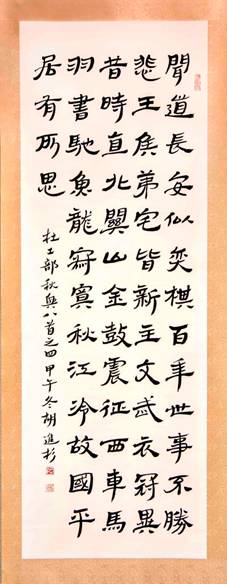
簡牘文字 杜甫 秋興八首之三 聞道長安似弈棋,百年世事不勝悲。 王侯第宅皆新主,文武衣冠異昔時。 直北關山金鼓振,征西軍馬羽書馳。 魚龍寂寞秋江冷,故國平居有所思。
Bamboo Slip Script (jiandu) Autumn Meditation 3 DU Fu (712-770 AD) Situations in Chang’an resemble a chessboard, it is said, A hundred years of vicissitude causes unbearable grief. All the royal residences accommodate new masters, Civil and military officers don attire different from those of the past. The Northern Territory frequents with confrontation alarms for the infringing Uygurs, The Western border shuttles with battlefields information against the invading Tibetans. The fish and dragons submerge in this lonely cold autumn river; Thinking of those peaceful days in my home my sorrow deepens. |
31.2 inches x 92.6 inches (Scroll) |
|
|
※ ※ ※ 簡牘文字:古人刻或寫在竹片、木片上的文字。簡牘是在紙普及之前用來記述的載體。所有出土古簡上之文字,皆用毛筆蘸黑墨書寫。未用漆書,亦不用刀刻。 漢簡:http://ndweb.iis.sinica.edu.tw/woodslip_public/System/Main.htm(僅中文) The Bamboo Slip Script was known to be carved or inscribed on long, narrow strips of bamboo before the invention of paper. Yet the texts on all of the excavated bamboo strips are discovered to be written by brush in black ink. None of them were written with paint or carved by knife. Please refer to the Bamboo Slip Script of the Han Dynasty: http://ndweb.iis.sinica.edu.tw/woodslip_public/System/Main.htm (Chinese only)
杜甫(712-770 AD),河南鞏縣人,作品對中國影響極深,傳詩約一千五百首。後人尊稱杜甫為「詩聖」,他的詩多描寫平民生活及戰亂流離,也被稱為「詩史」,是中國史上有名的社會詩人。 杜甫秋興八首,成詩於入夔後兩年(公元767年秋),也就是他死前兩年。在這八首詩作中,不斷的以覊旅夔州的失意心情,回顧當年在長安的京城盛狀,這八首詩,不但是他寫七言律詩的登峰造極之作,更是他心懷家國波瀾壯闊,卻始終顛簸的人生結束前嘔心瀝血之作。 DU Fu (712-770 AD) was born in Gong County of Henan Province. His extant works, numbering approximately fifteen hundred poems, hold enormous influence on Chinese literature. DU’s poetry reflects the conditions of his time, namely the turmoil and suffering caused by ongoing battles, periods of drought, starvation, and displacement. DU was honored by later generations as the “Poet-Historian” and the “Poet-Sage.” “Autumn Meditations” is a cycle of eight poems written in sepasyllabic regulated verse. Lauded as the poet’s magnum opus, the collection was written two years after DU arrived at Kwei County of Sichuan Province and two years before his death in Hunan. In these autumn muses, DU Fu laments the former glory of the Capital Chang’an devastated by the An-Shi Rebellion. This collection is the final work written during his lifetime and foreshadows the troublesome future of the Tang Dynasty.
白話譯文
首都長安的政軍情勢就像一局棋,想到過去百年的風雲變幻使我不勝傷悲。 秋天裏魚龍都潛伏在冷冽的深江裏,想起故國過去清靜承平的日子,又更加深了我心情的惆悵。 |
|
23 D |
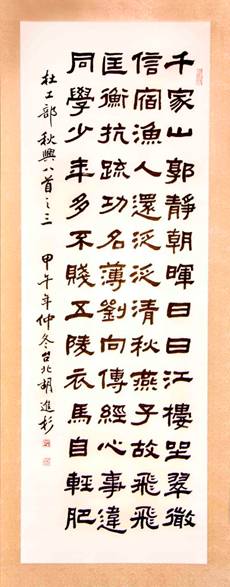
隸書 杜甫 秋興八首之四 千家山郭靜朝暉,日日江樓坐翠微。 信宿漁人還泛泛,清秋燕子故飛飛。 匡衡抗疏功名薄,劉向傳經心事違。 同學少年多不賤,五陵裘馬自輕肥。
Clerical Script (lishu) Autumn Meditation 4 DU Fu (712-770 AD) Thousands of houses bathing under the morning brightness; I indulge myself in watching colors of the blue ridge every day. After two nights, the fisherman continue to drift; Swallows persist hovering under the clear autumn sky. Emulating KUANG Heng’s admonition to the Emperor earned me scant honor; Following LIU Hsiang’s writing the history only led me astray. Most of my classmates are rich and famous, All to themselves, with fashionable clothes and steeds around the Five Mausoleums. |
31.2 inches x 92.6 inches (Scroll) |
|
|
※ ※ ※ 隸書:源於秦朝(221-206 BC),在東漢(25-220 AD)時期達到頂峰,故有「漢隸唐楷」之稱。秦始皇(260-210 BC)在書同文的過程中,命李斯(280-208 BC)創立小篆後,也採納了程邈(生卒年不詳)整理的隸書。小篆書寫速度較慢,而隸書化圓轉為方折,提高了書寫效率。 呂世宜(1784-1855 AD)隸書:http://www.npm.gov.tw/exh96/donation9604/ch02.html Although originating from the Qin Dynasty (221-206 BC), the Clerical Script reached its climax in the following Han Dynasty (206 BC-220 AD). In conjunction with the Small Seal Script by LI Si (280-208 BC), Qin Shi Huang (260-210 BC) also accepted the Clerical Script, compiled by CHENG Miao (birth and death unknown). The highly rectilinear structure of the Clerical Script makes it easier and faster to write than the Small Seal Script. Clerical Script by LU Shiyi (1784-1855 AD): http://www.npm.gov.tw/exh96/donation9604/en02.html
杜甫(712-770 AD),河南鞏縣人,作品對中國影響極深,傳詩約一千五百首。後人尊稱杜甫為「詩聖」,他的詩多描寫平民生活及戰亂流離,也被稱為「詩史」,是中國史上有名的社會詩人。 杜甫秋興八首,成詩於入夔後兩年(公元767年秋),也就是他死前兩年。在這八首詩作中,不斷的以覊旅夔州的失意心情,回顧當年在長安的京城盛狀,這八首詩,不但是他寫七言律詩的登峰造極之作,更是他心懷家國波瀾壯闊,卻始終顛簸的人生結束前嘔心瀝血之作。 DU Fu (712-770 AD) was born in Gong County of Henan Province. His extant works, numbering approximately fifteen hundred poems, hold enormous influence on Chinese literature. DU’s poetry reflects the conditions of his time, namely the turmoil and suffering caused by ongoing battles, periods of drought, starvation, and displacement. DU was honored by later generations as the “Poet-Historian” and the “Poet-Sage.” “Autumn Meditations” is a cycle of eight poems written in sepasyllabic regulated verse. Lauded as the poet’s magnum opus, the collection was written two years after DU arrived at Kwei County of Sichuan Province and two years before his death in Hunan. In these autumn muses, DU Fu laments the former glory of the Capital Chang’an devastated by the An-Shi Rebellion. This collection is the final work written during his lifetime and foreshadows the troublesome future of the Tang Dynasty.
白話譯文 山城籠罩在靜穆的晨暉當中,我每天坐在江樓俯覽淡青的山色。 過了兩晚,捕魚人還在捕魚未歸,没有歸巢的燕子也繼續四處飛翔。 我學匡衡那樣上疏議政卻不能貢獻國家,想師法劉向寫出傳世的篇章卻事與願違。 從前的玩伴都已身居高位,坐擁萬貫家財,自得其樂地優遊在五陵的風景區了。 |
|
|
23 E |
草書 杜甫 秋興八首之五 蓬萊宮闕對南山,承露金莖霄漢間。 西望瑤池降王母,東來紫氣滿函關。 雲移雉尾開宮扇,日繞龍麟識聖顏。 一臥滄江驚歲晚,幾回青鎖點朝班。
Cursive Script (caoshu) Autumn Meditation 5 DU Fu (712-770 AD) The Daming Palace faces Mt. South; Dew-collecting golden stalks of the Court reached nine clouds. Gazing west, the Queen Mother descended by Jade Lake, From the east, purple mist shrouded the Hangu Pass. In court, auspicious clouds moved over pheasants’ tail thus opened the Imperial Fan, Bathed in the shining sun of dragon scales, I had seen His Royal Highness. Now, in this remote area, amazed at how fast time has elapsed. I keep recalling those days preparing to go to the Court in the early morning. |
31.2 inches x 92.6 inches (Scroll) |
|
|
※ ※ ※ 草書:漢初,為減省或連綴隸書的筆畫,開始出現了隸書的草書,由於漢章帝(57-88 AD)喜好草書,因此被稱為章草,特點是字字獨立。後來楷書出現,逐漸出現楷書的草書,書寫迅速,往往上下字相連,稱為今草。到了唐朝,草書成為書法藝術,也演變出了「狂草」。 孫過庭(648-703 AD)《書譜》:http://www.npm.gov.tw/exh92/treasure/chinese/pic/t2-1.htm 及其釋文 http://www.npm.gov.tw/exh92/treasure/chinese/pic/t2-3.htm 狂草,唐懷素(錢藏真737-799 AD)《自敘帖》:http://www.npm.gov.tw/exh100/treasures/cn/images/img6_5s.jpg The Cursive Script (caoshu) functions primarily as a kind of shorthand script or calligraphic style. Developed during the Han Dynasty (206 BC-220 AD) as a cursory way to write the popular Clerical Script, the cursive way of writing was favored by Emperor Zhang (57-88 AD) of the Eastern Han Dynasty (25-220 AD) and called zhangcao. The characters of the Cursive Script are written closely and linked together. With the emergenAD of the Regular Script from the Wei Dynasty (220-265 AD) to the Jin Dynasty (265-420 AD), the Modern Cursive (jincao) was developed. Apart from the Clerical Cursive and the Modern Cursive styles, there is also the Wild Cursive (kuangcao) style which developed in the Tang Dynsaty (618-907 AD) and became exclusively an art form. Please refer to: “On Calligraphy” by SUN Guoting (648-703 AD): http://www.npm.gov.tw/exh92/treasure/chinese/pic/t2-1.htm As in modern print font http://www.npm.gov.tw/exh92/treasure/chinese/pic/t2-3.htm “Autobiography” by Huaisu (CHIEN Cangzhen, 737-799 AD): http://www.npm.gov.tw/exh100/treasures/cn/images/img6_5s.jpg
杜甫(712-770 AD),河南鞏縣人,作品對中國影響極深,傳詩約一千五百首。後人尊稱杜甫為「詩聖」,他的詩多描寫平民生活及戰亂流離,也被稱為「詩史」,是中國史上有名的社會詩人。 杜甫秋興八首,成詩於入夔後兩年(公元767年秋),也就是他死前兩年。在這八首詩作中,不斷的以覊旅夔州的失意心情,回顧當年在長安的京城盛狀,這八首詩,不但是他寫七言律詩的登峰造極之作,更是他心懷家國波瀾壯闊,卻始終顛簸的人生結束前嘔心瀝血之作。 DU Fu (712-770 AD) was born in Gong County of Henan Province. His extant works, numbering approximately fifteen hundred poems, hold enormous influence on Chinese literature. DU’s poetry reflects the conditions of his time, namely the turmoil and suffering caused by ongoing battles, periods of drought, starvation, and displacement. DU was honored by later generations as the “Poet-Historian” and the “Poet-Sage.” “Autumn Meditations” is a cycle of eight poems written in sepasyllabic regulated verse. Lauded as the poet’s magnum opus, the collection was written two years after DU arrived at Kwei County of Sichuan Province and two years before his death in Hunan. In these autumn muses, DU Fu laments the former glory of the Capital Chang’an devastated by the An-Shi Rebellion. This collection is the final work written during his lifetime and foreshadows the troublesome future of the Tang Dynasty.
白話譯文
猶記當年,大明宮遙望著終南山,承接天露的銅柱高聳入雲, |
|
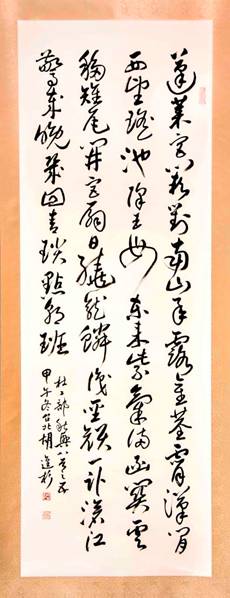
|
23 F |
行書 杜甫 秋興八首之六 瞿塘峽口曲江頭,萬里風煙接素秋。 花萼夾城通御氣,芙蓉小苑入邊愁。 珠簾繡柱圍黃鵠,錦纜牙檣起白鷗。 回首可憐歌舞地,秦中自古帝王州。
Running Script (xingshu) Autumn Meditation 6 DU Fu (712-770 AD) Standing by the mouth at the Qutang Gorge reminds me of those days by the bank of the Qu River, Ten thousand miles of wind and mist join them in pale autumn. The Hua’er Terrance and its corridor provided access for the Emperor to brother Princes; The Fuzong Park and its petite gardens are invaded by the Tibetan rebels. Yellow cranes surrounded by embroidered pillars and beaded nets, White gulls agitated by boat with brocaded ropes and ivory mast. Reflecting those places used to have dancing and singing, Alas! Qin Zhong has been since olden days the land of Emperors! |
31.2 inches x 92.6 inches (Scroll) |
|
|
※ ※ ※ 行書:介於楷書及草書間的一種字體。楷書的草化,或草書的楷化。一說是在東漢(25-220 AD)年間劉德升(生卒年不詳)所創。 王羲之(303-361 AD)《蘭亭集序》、顏真卿(709-785 AD)《祭侄文稿》、蘇軾(1037-1101 AD)《寒食帖》並稱三大行書,真跡現皆存藏於中華民國國立故宮博物院,相關網站如下: 祭侄文稿:http://www.npm.gov.tw/exh97/chintang/cht_image5.html 寒食帖:http://www.npm.gov.tw/zh-tw/Article.aspx?sNo=04001005 The Running Script (xingshu) is a style of calligraphy containing elements of both the Regular Script and Cursive Script styles. Legend has it that the Running Script was founded by LIU De-sheng (birth and death unknown) during the Eastern Han Dynasty (25-220 AD). All of the best and representative manifestations of Running Script writings-i.e., “The Orchid Pavilion Preface” by WANG Xizhi (303-361 AD), “Draft of Eulogy to My Nephew” by YEN Zhenqing (709-785 AD), and “The Cold Food Observance” by SU Shi (1037-1101 AD)-are preserved at the National Palace Museum in Taipei, Republic of China (Taiwan). The linked web pages are as follows: Draft of Eulogy to My Nephew: http://www.npm.gov.tw/exh97/chintang/cht_image5.html The Cold Food Observance: http://www.npm.gov.tw/zh-tw/Article.aspx?sNo=04001005
杜甫(712-770 AD),河南鞏縣人,作品對中國影響極深,傳詩約一千五百首。後人尊稱杜甫為「詩聖」,他的詩多描寫平民生活及戰亂流離,也被稱為「詩史」,是中國史上有名的社會詩人。 杜甫秋興八首,成詩於入夔後兩年(公元767年秋),也就是他死前兩年。在這八首詩作中,不斷的以覊旅夔州的失意心情,回顧當年在長安的京城盛狀,這八首詩,不但是他寫七言律詩的登峰造極之作,更是他心懷家國波瀾壯闊,卻始終顛簸的人生結束前嘔心瀝血之作。 DU Fu (712-770 AD) was born in Gong County of Henan Province. His extant works, numbering approximately fifteen hundred poems, hold enormous influence on Chinese literature. DU’s poetry reflects the conditions of his time, namely the turmoil and suffering caused by ongoing battles, periods of drought, starvation, and displacement. DU was honored by later generations as the “Poet-Historian” and the “Poet-Sage.” “Autumn Meditations” is a cycle of eight poems written in sepasyllabic regulated verse. Lauded as the poet’s magnum opus, the collection was written two years after DU arrived at Kwei County of Sichuan Province and two years before his death in Hunan. In these autumn muses, DU Fu laments the former glory of the Capital Chang’an devastated by the An-Shi Rebellion. This collection is the final work written during his lifetime and foreshadows the troublesome future of the Tang Dynasty.
白話譯文
站在瞿塘峽,回想曲江頭,兩地都是蕭瑟的秋意。 |
|
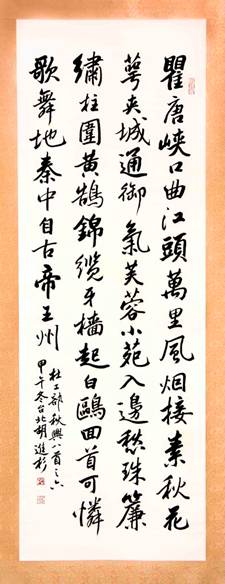
|
23 G |
魏碑 杜甫 秋興八首之七 昆明池水漢時功,武帝旌旗在眼中。 織女機絲虛夜月,石鯨麟甲動秋風。 波漂菰米沉雲黑,露冷蓮房墜粉紅。 關塞極天惟鳥道,江湖滿地一漁翁。
Wei Stele Script (weibei) Autumn Meditation 7 DU Fu (712-770 AD) Kunming Lake reflected the feats of the Han Dynasty, Emperor Wu's flying standards and banners are still within sight; Idle are the weaving girl’s loom and thread beneath the moon. The stone whale roars against autumn wind; Pitched-dark Zizania seeds cover all the water, Rouge flower of lotus leave unharvested seedpods; Stranded in this deep forest (of Kuei) only birds can fly out, I am but a lost and homeless fisherman in rivers and lakes.
|
31.2 inches x 92.6 inches (Scroll) |
|
|
※ ※ ※ 魏碑:也稱北碑,是南北朝時期北朝的碑刻書法作品。現存的魏碑書體都是楷書,因此有時也把這些楷書碑刻作品稱為「魏楷」。這些碑刻作品主要是以「石碑」、「墓誌銘」、「摩崖」和「造像記」的形式存在的。 The Wei Stele Inscription (weibei) refers to the calligraphic works on stele inscriptions of the Northern Dynasty (439-581 AD) in the period of the Northern and Southern Dynasties (420-589 AD). The style is characterized by elegant, natural, and poised strokes, emitting a sense of sturdiness and simplicity.
杜甫(712-770 AD),河南鞏縣人,作品對中國影響極深,傳詩約一千五百首。後人尊稱杜甫為「詩聖」,他的詩多描寫平民生活及戰亂流離,也被稱為「詩史」,是中國史上有名的社會詩人。 杜甫秋興八首,成詩於入夔後兩年(公元767年秋),也就是他死前兩年。在這八首詩作中,不斷的以覊旅夔州的失意心情,回顧當年在長安的京城盛狀,這八首詩,不但是他寫七言律詩的登峰造極之作,更是他心懷家國波瀾壯闊,卻始終顛簸的人生結束前嘔心瀝血之作。 DU Fu (712-770 AD) was born in Gong County of Henan Province. His extant works, numbering approximately fifteen hundred poems, hold enormous influence on Chinese literature. DU’s poetry reflects the conditions of his time, namely the turmoil and suffering caused by ongoing battles, periods of drought, starvation, and displacement. DU was honored by later generations as the “Poet-Historian” and the “Poet-Sage.” “Autumn Meditations” is a cycle of eight poems written in sepasyllabic regulated verse. Lauded as the poet’s magnum opus, the collection was written two years after DU arrived at Kwei County of Sichuan Province and two years before his death in Hunan. In these autumn muses, DU Fu laments the former glory of the Capital Chang’an devastated by the An-Shi Rebellion. This collection is the final work written during his lifetime and foreshadows the troublesome future of the Tang Dynasty.
白話譯文
遙想漢朝曾為操練水兵而建的昆明池上,武帝的軍威與旌旗迎風招展。 |
|
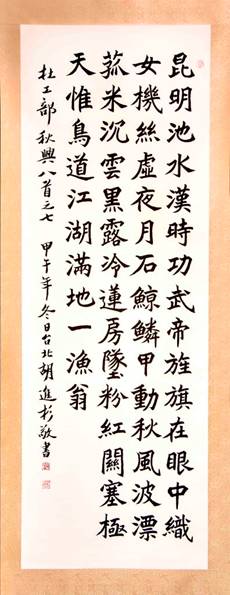
23 H |
唐楷 杜甫 秋興八首之八 昆吾御宿自逶迤,紫閣峰陰入渼陂。 香稻啄殘鸚鵡粒,碧梧棲老鳳凰枝。 佳人拾翠春相問,仙侶同舟晚更移。 綵筆昔曾干氣象,白頭吟望苦低垂。
Regular Script (kaishu) Autumn Meditation 8 DU Fu (712-770 AD) From Kuenwu to Yusyu roads meandered, The shadow from the Purple Pavilion Peaks reflected in Pond Mei; Aromatic rice still abundant after consumed by parrots, Green wutong trees attracted aged Phoenix; Exquisite lass picks feathers for spring, Boating friends like immortals ignore the deep night; My florid brush once defined state affairs, My white head drones and gazes, bitterly hanging low. |
31.2 inches x 92.6 inches (Scroll) |
|
|
※ ※ ※ 唐楷:唐朝(618-907 AD)在楷書方面的成就最為後世推崇,字體以法度嚴謹著稱,在中國書法史上與秦篆與漢隸並列。 The Regular Script (kaishu) is considered to have matured stylistically during the Tang Dynasty (618-907 AD). It is famous for the strictness and clearness of its strokes. In Chinese calligraphy, the Regular Script of the Tang Dynasty ranks alongside the Small Seal Script of the Qin Dynasty (221-206 BC) and the Clerical Script of the Han Dynasty (206 BC-220 AD).
杜甫(712-770 AD),河南鞏縣人,作品對中國影響極深,傳詩約一千五百首。後人尊稱杜甫為「詩聖」,他的詩多描寫平民生活及戰亂流離,也被稱為「詩史」,是中國史上有名的社會詩人。 杜甫秋興八首,成詩於入夔後兩年(公元767年秋),也就是他死前兩年。在這八首詩作中,不斷的以覊旅夔州的失意心情,回顧當年在長安的京城盛狀,這八首詩,不但是他寫七言律詩的登峰造極之作,更是他心懷家國波瀾壯闊,卻始終顛簸的人生結束前嘔心瀝血之作。 DU Fu (712-770 AD) was born in Gong County of Henan Province. His extant works, numbering approximately fifteen hundred poems, hold enormous influence on Chinese literature. DU’s poetry reflects the conditions of his time, namely the turmoil and suffering caused by ongoing battles, periods of drought, starvation, and displacement. DU was honored by later generations as the “Poet-Historian” and the “Poet-Sage.” “Autumn Meditations” is a cycle of eight poems written in sepasyllabic regulated verse. Lauded as the poet’s magnum opus, the collection was written two years after DU arrived at Kwei County of Sichuan Province and two years before his death in Hunan. In these autumn muses, DU Fu laments the former glory of the Capital Chang’an devastated by the An-Shi Rebellion. This collection is the final work written during his lifetime and foreshadows the troublesome future of the Tang Dynasty.
白話譯文
從長安起一路蜿蜒,途徑昆吾和御宿亭,直到有紫閣峰倒映的渼陂塘。
春天了,曼妙的仕女們在風景中踏青,書生雅士們則塘上夜泛,忘卻了歸家的時程。 |
|


文字編撰:王贊禹、盧浩文、黃肇輝、李素娜、邱曉琦、劉金鵬、賴媤琍、張子慧。
Chinese and English text compiled and edited by Philip WANG, Edward LOUK, Debbie HUANG, Suna LEE, Hsiao-Chi CHIU, Leo LIU, Alexandra Reed LASLEY, and Joanna CHANG.
攝影:倪美蓉