20
西夏文 金剛經 第三十二分
須菩提!若有人以滿無量阿僧祇世界七寶,持用布施。若有善男子、善女人,發菩提心者,持於此經,乃至四句偈等,受持、讀誦,為人演說,其福勝彼。云何為人演說?不取於相,如如不動。何以故?一切有為法,如夢幻泡影;如露亦如電,應作如是觀。
West Xia Regime (1032-1227 AD) Script (xixiawen) with original Han Script (hanwen)
The Diamond Sutra, Chapter 32
The Buddha said to Subhuti: “If anyone gave to the Buddha an immeasurable quantity of the seven treasures sufficient to fill the whole universe; and if another person, whether a man or a woman, in seeking to attain complete Enlightenment were to earnestly and faithfully observe and study even a single verse of this Sutra and explain it to others, the accumulated blessing and merit of that latter person would be far more.
Subhuti, how can one explain this Sutra to others without holding in mind any arbitrary conception of forms or phenomena or spiritual truths? It can only be done, Subhuti, by keeping the mind in perfect tranquility and free from any attachment to appearances.
So
I say unto you—
This is how to contemplate our transient existence in this mundane world:
Like
a tiny drop of dew, or a bubble floating in a stream;
Like a flash of lightning in the sky,
Or an illusion, a phantom, or a dream.
So is all conditioned existence to be seen.”
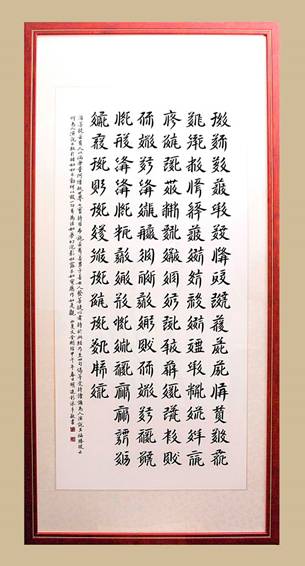
65.6 inches x 24 inches
※ ※ ※
西夏(1038-1227 AD):為原居四川松潘高原的黨項族所建,唐朝(618-907 AD)時遷居陝北。先後臣服於唐朝、五代諸朝(897-979 AD)與宋朝(960-1279 AD)。金朝(1115-1234 AD)崛起並滅遼(916-1225 AD)、北宋(960-1127 AD)後,與西夏建立同盟。蒙古帝國(1206-1259 AD)崛起,六次入侵西夏, 於公元1227年亡於蒙古。
The West Xia Regime (1038-1227 AD) inherited the political and social structures of the Tang Dynasty (618-907 AD), further developing an already outstanding civilization. Their territory encompassed the present Ningxia, Gansu, eastern Qinghai, and northern Shaanxi region, covering approximately 310,000 square miles. In the beginning of the thirteenth century, Genghis Khan (1162-1227 AD) unified the northern grasslands of Mongolia and led the Mongol troops to carry out six rounds of attacks against the West Xia Regime. After the West Xia capital was overrun in 1227 AD, the Mongols annihilated its architecture and written records.
金剛經:佛教一部很重要的經典,對中華文化與禪宗有著鉅大的影響。整部經的要旨在闡述宇宙萬法皆假因緣和合而生,緣聚則生,緣散則滅,故空無實體,以此令眾生了悟諸法無我、諸行無常之理,進而能去除對世間一切相的執著,過著無住的生活得解脫自在。另一方面說明般若智慧人人本具,不假外求,祇能向內心去挖掘。
從《金剛經》中可以如實了知,佛教是以人為本的人間佛教,修行是在日常生活中修,離開生活也就没有「般若」,也就無法了解「空」理了。
20世紀初出土於敦煌的《金剛經》,印於唐懿宗(859-873 AD)咸通九年(868 AD),為現存世界最早的印刷品之一,藏於大英圖書館。其較古騰堡於1455年在德意志採用活字印刷術印刷的《古騰堡聖經》大約早587年。
請參見:http://lib.ihp.sinica.edu.tw/pages/03-rare/dunhuang/01-1.htm或http://idp.bl.uk
The Diamond Sutra is one of the most important Buddhist sutras (scriptures). It has tremendous influence on Chinese culture and in Zen Buddhism. The theme of the sutra lies in revealing the fact that all phenomena and everything in the universe are created and terminated according to previous causes or chance meetings of certain circumstances. Nothing has a fixed nature in its own right. As a result, we can therefore realize the fundamental principles that nothing lasts forever and there is no “I.” Furthermore, people can lead an unencumbered and carefree life by removing all sorts of attachments.
On the other hand, the sutra also illustrates that everyone has the intrinsic Prajñāpāramitā, or “Perfection of Wisdom” which does not require outward searching. It exists right in our hearts. The sutra clearly shows that the core of Buddhist philosophy is to humanize Buddhism, and we should cultivate our spirituality in daily life. There will be no Prajñā (Wisdom) if we fail to cultivate and practice it in daily life, and we certainly will not be able to comprehend the true meaning of “void.”
A copy of the Chinese version of The Diamond Sutra, found among the Dunhuang manuscripts in the early 20th century by Aurel Stein, dates back to May 11, 868 AD. It is, in the words of the British Library, “the earliest complete survival of a dated printed book.” This is approximately 587 years before the Gutenberg Bible was first printed in Germany in 1455.
Please visit: http://lib.ihp.sinica.edu.tw/pages/03-rare/dunhuang/01-1.htm or http://idp.bl.uk
白話譯文
佛對須菩提說:如果有人以無量無數的世界七寶廣為布施,當然多福;但比起普通的善男信女,發廣大普濟的大願,受持金剛經,不但要求自己明心見性,還到處傳布,助人能自見其性,這後一種的福報,比前一種更多。但應如何傳布呢﹖要不著相,要不動心。這是什麼緣故呢?因為凡世間,一切作為,現滅不常,如同夢境、如同幻緣、如同浮泡、如同虛影、如同朝露即乾、如同電光忽過,凡屬有為,要以領悟這六種現象的心態去觀察與認知。
