17
行書 韋應物 滁州西澗
獨憐幽草澗邊生,上有黃鸝深樹鳴。
春潮帶雨晚來急,野渡無人舟自橫。
Running Script (xingshu)
At Chuzhou on the Western Stream
WEI Yingwu (737-791 AD)
I only like the tender grasses that spread along the stream,
where trills of orioles echo in the forest’s deep shade.
The downpour of last night’s rain hastens the speed of floods,
an unguarded ferryboat docks at the water near the ferry.
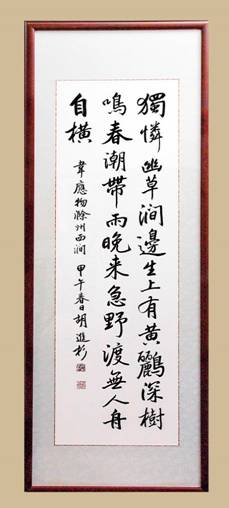
20.4 inches x 58 inches
※ ※ ※
行書:介於楷書及草書間的一種字體。楷書的草化,或草書的楷化。一說是在東漢(25-220 AD)年間劉德升(生卒年不詳)所創。
王羲之(303-361 AD)《蘭亭集序》、顏真卿(709-785 AD)《祭侄文稿》、蘇軾(1037-1101 AD)《寒食帖》並稱三大行書,真跡現皆存藏於中華民國國立故宮博物院,相關網站如下:
祭侄文稿:http://www.npm.gov.tw/exh97/chintang/cht_image5.html
寒食帖:http://www.npm.gov.tw/zh-tw/Article.aspx?sNo=04001005
The Running Script (xingshu) is a style of calligraphy containing elements of both the Regular Script and Cursive Script styles. Legend has it that the Running Script was founded by LIU De-sheng (birth and death unknown) during the Eastern Han Dynasty (25-220 AD).
All of the best and representative manifestations of Running Script writings-i.e., “The Orchid Pavilion Preface” by WANG Xizhi (303-361 AD), “Draft of Eulogy to My Nephew” by YEN Zhenqing (709-785 AD), and “The Cold Food Observance” by SU Shi (1037-1101 AD)-are preserved at the National Palace Museum in Taipei, Republic of China (Taiwan). The linked web pages are as follows:
Draft of Eulogy to My Nephew: http://www.npm.gov.tw/exh97/chintang/cht_image5.html
The Cold Food Observance: http://www.npm.gov.tw/zh-tw/Article.aspx?sNo=04001005
韋應物(737-792 AD),長安杜陵人(今陜西省西安)。曾任蘇州刺史。一生嚮往山野林泉,故詩作多描寫田園風物,詩風淡泊樸實、高雅空靈。山水詩中亦不乏雄豪氣勢。
WEI Ying-wu (737-792 AD) was born in Duling, Changan (now Xian, Shanxi Province). Formerly serving as the Suzhou magistrate, WEI greatly loved his beautiful and idyllic surroundings, which are reflected in his graceful poetry. Lyrical and elegant, his shan shui (mountain and stream) poetry contains an air of heroic grandeur.
白話譯文
獨獨憐愛澗邊生長的幽幽小草,樹陰深處黃鶯自得的啼鳴。
前晚的春雨使潮水漲得更急,郊野渡口上,没人看顧的渡船兀自橫泊在河裏。
