16
草書 李商隱 隋宮
紫泉宮殿鎖煙霞,欲取蕪城作帝家,
玉璽不緣歸日角,錦帆應是到天涯。
於今腐草無螢火,終古垂楊有暮鴉,
地下若逢陳後主,豈宜重問後庭花。
Cursive Script (caoshu)
The Palace of the Sui Dynasty
Li Shangyin (813-858 AD)
The Palace of Sui has soared and been absorbed in the clouds,
Emperor Suiyang desires to relocate his Capital to Yangzhou.
Had the Imperial Seal not been seized by the Prince of Tang,
Sui’s brocaded boat could have sailed to every corner of China.
Now fireflies flying in rotten meadows disappear;
to the ancient willow trees crows still return at sunset.
Should he meet the dethroned Emperor Chen in the netherworld,
would it be appropriate for him to even mention the song Harem Flowers?
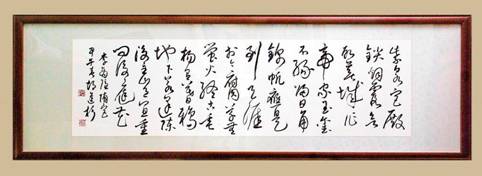
65.5 inches x 21 inches
※ ※ ※
草書:漢初,為減省或連綴隸書的筆畫,開始出現了隸書的草書,由於漢章帝(57-88 AD)喜好草書,因此被稱為章草,特點是字字獨立。後來楷書出現,逐漸出現楷書的草書,書寫迅速,往往上下字相連,稱為今草。到了唐朝,草書成為書法藝術,也演變出了「狂草」。
孫過庭(648-703 AD)《書譜》:http://www.npm.gov.tw/exh92/treasure/chinese/pic/t2-1.htm
及其釋文 http://www.npm.gov.tw/exh92/treasure/chinese/pic/t2-3.htm
狂草,唐懷素(錢藏真737-799 AD)《自敘帖》:http://www.npm.gov.tw/exh100/treasures/cn/images/img6_5s.jpg
The Cursive Script (caoshu) functions primarily as a kind of shorthand script or calligraphic style. Developed during the Han Dynasty (206 BC-220 AD) as a cursory way to write the popular Clerical Script, the cursive way of writing was favored by Emperor Zhang (57-88 AD) of the Eastern Han Dynasty (25-220 AD) and called zhangcao. The characters of the Cursive Script are written closely and linked together. With the emergence of the Regular Script from theWei Kingdom (220-265 AD) to the Jin Dynasty (265-420 AD), the Modern Cursive (jincao) was developed. Apart from the Clerical Cursive and the Modern Cursive styles, there is also the Wild Cursive (kuangcao) style which developed in the Tang Dynasty (618-907 AD) and became exclusively an art form.
Please refer to:
“On Calligraphy” by SUN Guoting (648-703 AD): http://www.npm.gov.tw/exh92/treasure/chinese/pic/t2-1.htm
As in modern print font http://www.npm.gov.tw/exh92/treasure/chinese/pic/t2-3.htm
“Autobiography” by Huaisu (CHIEN Cangzhen, 737-799 AD): http://www.npm.gov.tw/exh100/treasures/cn/images/img6_5s.jpg
李商隱(813-858 AD),字義山,自號玉谿生,懷州(今河南沁陽)人。中國詩史上最唯情的詩人。時代環境的壓力及錯亂反常的命運造成他悲劇性的性格,才氣超乎常人,感情豐富細膩,詩中多呈現淒美之的魅力。由於極為關心現實和國家命運,現存約六百首詩中,有關時政的詩佔了六分之一。
LI Shang-yin (813-858 AD), born in Huaizhou (now Xinyan, Henan Province), was one of the most passionate poets in the history of Chinese literature. LI’s tragic character was formed out of the pressure of his living environment and his deranged fate. Being a talented and passionate poet, LI often conveyed charming pathos in his poems. His concern about the fate of the state is seen in that one sixth of his 600 poems focus on the politics of his time.
陳後主:(陳叔寶553-604 AD)南北朝時陳朝末代皇帝,在位七年(583-589 AD)。性淫逸、縱酒、好做艷辭,不理朝政,亡於隋。
Dethroned Chen Emperor, CHEN Shubao (553-604 AD) was the last emperor of the Chen Dynasty. During his reign he indulged himself in women and wine, ignoring state affairs. He was dethroned by the Sui Dynasty. Harem Flowers is one of his most infamous songs of lust.
白話譯文
在長安城的隋宮,鎖閉在籠罩的煙霞之中;隋煬帝卻想把遙遠的揚州作為帝業基地。
若不因天命,玉璽歸屬龍鳳之姿的李淵;隋煬帝的錦緞龍舟,早已該駛遍天際。
如今腐草中,螢火蟲已絕了蹤跡;隋堤的楊柳枝上,唯有暮鴉的聒啼。
隋煬帝荒淫而亡國,黃泉若遇陳後主,豈敢再提亡國的歌舞曲《後庭花》?

