3
石鼓文 第二鼓 汧殹篇
汧殹沔沔,丞皮淖淵。
𩷑鯉處之,君子漁之。
澫又(有)小魚,其斿𧽾𧽾。
帛魚𤾾𤾾,其𥶎氐鮮。
黃白其𩺂,又(有)鰟又(有)𩸊。
其𦚎孔庶,臠之𣬐𣬐。
𡊺𡊺𧽢𧽢,其魚隹(唯)可(何)?
隹(唯)鱮隹(唯)鯉,可(何)以𣞉之,隹(唯)楊及柳。
Stone Drum Script (shiguwen)
Second Drum: Qian River
Quietly flows the Qian River, forming deep muddy ponds here and there;
with shoals of catfishes and carps, there comes King Qin to fish.
Carefree swim small fishes in the gully, scales flashing in the water;
fresh fishes struggle in the bamboo traps. What a sight!
Yellow breams and white mud carps, abounding in pairs;
fish flip and flop in migration. What are the catches? Chubs and carps.
How to preserve them? Poplars and willows everywhere to make the containers.
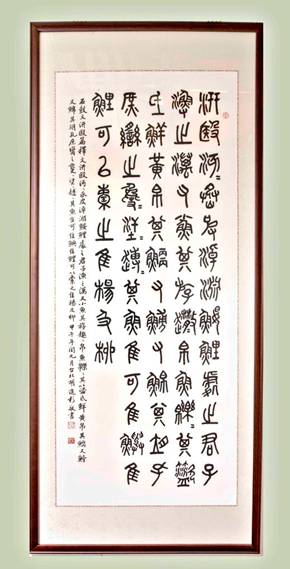
33.3 inches x 78.6 inches
※ ※ ※
石鼓文,先秦刻石文字,因其刻石外形似鼓而得名。發現於唐初,共十枚,徑約三尺,分別刻有大篆四言詩一首,共十首,計七百一十八字。內容最早被認為是記敘周宣王出獵的場面,故又稱獵碣。因被棄於陳倉之野,同時也稱陳倉十碣。
The Stone Drums are ten granite boulders bearing the oldest known drum shape “stone” inscriptions in ancient Chinese. The ten Stone drums were excavated in the beginning of Tang Dynasty (618-907 AD) in the rural area of Chengcang (now Baoji of Shanxi Province), There are four-character poems carved on each stone with 718 Large Seal Script characters in total. There are several interpretations of their origin. The Stone Drums are the oldest known stone inscriptions in China, making them a priceless treasure for epigraphers. The Drums vary in height from 73 cm to 87.5 cm (with one which was at one point used as a mortar reduced by the grinding to 58 cm), and from 56 to 80.1 cm in diameter. The Stone Drums weigh about 882 pounds each.
白話譯文(中華民國國立故宮博物院器物處前處長張光遠先生譯文)
啊!汧水湧流,注成了許多泥潭。
潭中有鰋魚及鯉魚,秦君來釣魚了!
石澗處有小魚,悠閒自在地游著;
白色的魚,在水中閃鑠著,捕魚籠裏的魚,活鮮鮮的,實在美極了!
黃色的魴魚及白色的鮊魚,成雙結對地並游著。
一眼看去,好多啊!魚腹疾速翻閃。
成羣地往來迴游著。所釣的是什麼魚呀!
是鰱魚及鯉魚。用什麼來裝盛呢?到處有楊條柳條可取材作盛具哩!
