2
鐘鼎文 論語 學而篇
有子曰:禮之用,和為貴,先王之道斯為美。小大由之,有所不行,知和而和,不以禮節之,亦不可行也。
Bronze Vessel Script (zhongdingwen)
The Analects, Xue-Er Chapter
YOU Tzu said, “In the actual practice of propriety, harmony is essential. This is what the ancient kings did so well—both the greater and the lesser abide by it. Yet be aware: if you understand harmony and use it, but do not structure yourself with propriety, things will not go well.”
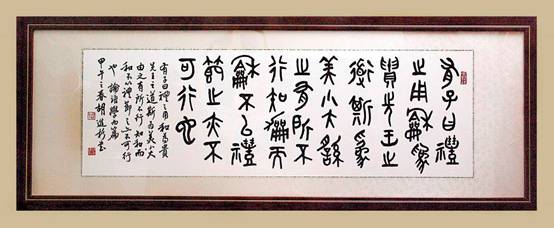
65.6 inches x 24 inches
※ ※ ※
鐘鼎文:亦稱金文,乃鑄或刻於青銅器上之文字。始於商朝晚期,盛於西周,紀錄內容多為當時社會,尤其是王公貴族的活動,多為祀典、賜命、征伐、圍獵及契約之事。以周宣王時期所鑄毛公鼎金文(又稱西周金文)為代表。迄今發現的鐘鼎文,經統計,共有3,005字,可辨識者1,804字,比甲骨文略多。由於商周盛行青銅器,而青銅禮器以「鼎」為代表,樂器以「鐘」為代表,因其刻於金器、大鐘上,故稱鐘鼎文。
請參見西周晚期宗周鐘及其銘文:
http://www.npm.gov.tw/exh99/bell/2_en.htm
http://www.npm.gov.tw/exh99/bell/big006_en.htm
http://www.npm.gov.tw/exh99/bell/big007_en.htm
http://www.npm.gov.tw/exh99/bell/big008_en.htm
毛公鼎文字:
http://www.npm.gov.tw/exh99/bell/big001_en.htm
http://www.npm.gov.tw/exh99/bell/big002_en.htm
http://www.npm.gov.tw/exh99/bell/big004.htm
The Bronze Vessel Script, also commonly referred to as the Bronze Script, were writing on ritual bronzes such as zhōng (bells) and ding (tripodal cauldrons) from the Shang Dynasty (1765-1122 BC) to the Zhou Dynasty (1121-249 BC) and even later. Early bronze inscriptions were almost always cast with a stylus in the wet clay of the piece-mold from which the bronze was then cast, while later inscriptions were often engraved after the bronze was cast. Inscriptions recorded activities for contemporary affairs, including those involving rituals, conferring positions or assignments, expeditions and battles, hunting, and making contracts among nobilities.
Please refer to Zong Zhou Zhong of the Late Western Zhou Dynasty and its casted script:
http://www.npm.gov.tw/exh99/bell/2_en.htm
http://www.npm.gov.tw/exh99/bell/big006_en.htm
http://www.npm.gov.tw/exh99/bell/big007_en.htm
http://www.npm.gov.tw/exh99/bell/big008_en.htm
Mao Gong Ding and its casted script:
http://www.npm.gov.tw/exh99/bell/big001_en.htm
http://www.npm.gov.tw/exh99/bell/big002_en.htm
http://www.npm.gov.tw/exh99/bell/big004.htm
論語:孔子和他的弟子及再傳弟子言行為主的匯編,是儒家重要的經典之一。
The Analects is a collection of aphorisms from Confucius, his disciples, and his disciples’ disciples. It is the most important book in Confucianism.
孔子(551-479 BC),名丘,字仲尼。春秋末期魯國教育家與哲學家,曾任魯大司寇。刪詩書、訂禮樂、贊周易、著春秋,是儒學和儒家的創始人。學不厭、教不倦,使孔子成為「至聖先師」。他主張有教無類,將前此貴族所獨有之禮樂教育普及於平民,學生多至三千人。西漢武帝時,董仲舒(179-104 BC)進言罷黜百家獨尊儒術,奠定了儒家兩千年來的正統學派地位,孔子並被尊為萬世師表。
Confucius (551-479 BC) was born into a rather impoverished family of noble descent in Lu State (within modern Shantung Province). His Chinese name was KONG Chiu, with a courtesy name Zhong-ni. After resigning from his post as minister of Lu State, he travelled to many parts of China. He was, and still is, regarded as the most famous Chinese philosopher and educator. His policy was to accept any person as a disciple, provided that the student was genuinely eager to learn. This idea was revolutionary in a society in which education was the exclusive privilege of the aristocracy. He is credited with educating 3,000 students. He is also one of the first Chinese philosophers to leave behind a collection of teachings that can be reliably ascribed to his philosophy - The Analects. Confucius authored or edited the following works: Classics of Poetry, Book of Documents, Book of Rites, I Ching, and the Spring and Autumn Annals. During the reign of Emperor Wu of the West Han Dynasty (141-87 BC), the Confucian scholar and Imperial courtier DONG Zhong-Su (179-104 BC) recommended and adopted the policy to “reject other schools of thoughts, [and] respect only Confucianism.” Since then, Confucius was highly regarded as the Model for All Ages.
有子,即有若(518-458 BC),字子有,魯國人。「七十二賢」之一。
YOU Tzu (518-458 BC), one of Confucius’ 72 best disciples, also born in Lu State.
白話譯文
有子說:禮法的運用,以和為貴。這是最美好的傳統,適用於一切事情。但僅知道「和為貴」是不行的,違反禮法而講「和」是絕對不行的。
